
ATCS for Marine and Offshore Condensers
Seawater-cooled condensers on ships, FPSOs and offshore platforms suffer from barnacle, mussel and salt fouling. Manual cleaning in a marine engine room is time-consuming and costly.
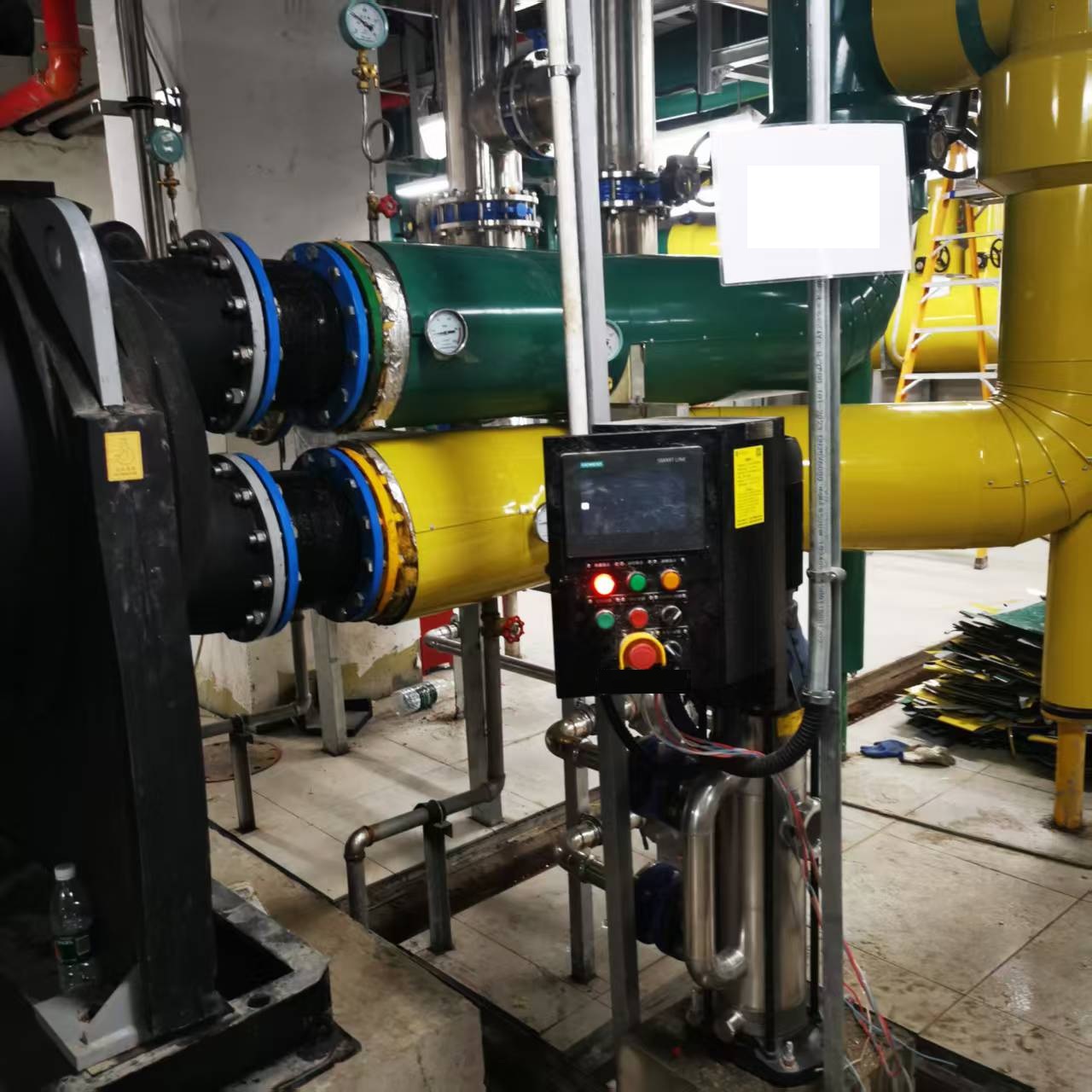
Key Benefits for Marine & Offshore
Reduce Salt & Biofouling
Continuous ball wiping limits marine growth before it hardens.
Cut Port Maintenance
Fewer dry-dock or in-port cleaning events.
Seawater-Grade Materials
316L, duplex and GRP-lined components resist corrosion.
Compact Footprint
Skids designed for tight engine rooms and deck spaces.
Typical System Configuration
Marine ATCS uses corrosion-resistant collectors, shock-rated pumps and IP65 panels. Systems are built to classification society requirements and supplied with commissioning procedures for shipyard installation.
| Item | Specification |
|---|---|
| Applicable tube ID | 12 – 30 mm (custom up to 45 mm) |
| Ball material | EPDM, oil and seawater resistant |
| Collector material | Carbon steel / 316L SS / Duplex SS |
| Control | Siemens PLC, Modbus/BACnet to BMS |
| Communication | Remote monitoring and alarm feedback |
Frequently Asked Questions
Seawater Cooling: Biofouling, Chlorides and Space
Marine and offshore cooling presents a combination that is hard on heat exchangers: seawater as the cooling medium, limited space for equipment, and an operating context where taking a cooler out of service is rarely convenient. Each of those constraints shapes how cleaning has to be done.
Biofouling is usually the dominant mechanism rather than mineral scale. Seawater carries larvae, bacteria and organic load that colonise tube surfaces quickly, and a biofilm layer is both a thermal barrier and a surface that traps further deposit. Chlorides add a corrosion dimension, which is why tube alloys in seawater service are typically copper-nickel, titanium or high-grade stainless rather than plain copper.
Space is the quiet constraint. On a vessel or platform, the footprint available for a cleaning skid and collector is often decided by what fits the compartment rather than what is ideal hydraulically. This makes compact collector design and flexible installation geometry more important than in a land-based plant room.
Continuous cleaning suits this environment because it does not require the cooler to be opened. In service where opening a cooler means isolation, drainage, permits and possibly a yard period, keeping the tubes clean without breaking into the system is worth more than the energy recovered.
Specification Considerations in Marine Service
| Consideration | What it drives |
|---|---|
| Tube alloy (Cu-Ni / Ti / SS) | Ball hardness and grade selection |
| Intake debris load | Strainer and collector screen specification |
| Available footprint | Compact vs standard collector arrangement |
| Motion and vibration | Mounting and pipe support design |
Marine & Offshore Questions
Is this suitable for vessels as well as platforms?
Yes. The same principle applies to shipboard seawater coolers and to platform cooling systems. The differences are in mounting arrangement, materials for the marine environment and how maintenance access is arranged — all of which are addressed at specification stage rather than being obstacles.
Does it replace the need for electrolytic or chemical antifouling?
No. Those methods reduce settlement; mechanical cleaning removes what has settled. In seawater service most operators run both, because the biological load is high enough that neither method alone keeps surfaces consistently clean. Continuous cleaning also reduces how aggressively the chemical or electrolytic side has to be run.
How is maintenance handled at sea?
Routine attention is limited to ball replenishment and periodic screen inspection, both performed without opening the cooler. Consumables can be carried as spares. There is no requirement for specialised tooling or for the system to be taken out of service for cleaning.
Can you classify to a marine society?
We supply equipment to owner and yard specification and provide the documentation package — drawings, material certificates and test records — that class submission requires. Where class approval is needed, this is addressed during proposal stage so there are no surprises after order.
Get a Marine & Offshore ATCS Quote
Tell us your chiller / condenser model, cooling capacity and water quality. We reply within 24 hours with a tailored solution and ROI estimate.
Prefer email? Write to michealzhang969@gmail.com
Explore more in our Automatic Condenser Tube Cleaning (ATCS) →