
Automatic Condenser Tube Cleaning for Power Plants
In thermal and combined-cycle power plants, steam surface condenser vacuum is directly tied to turbine efficiency. Tube fouling raises condenser back-pressure, reduces output and increases heat rate.
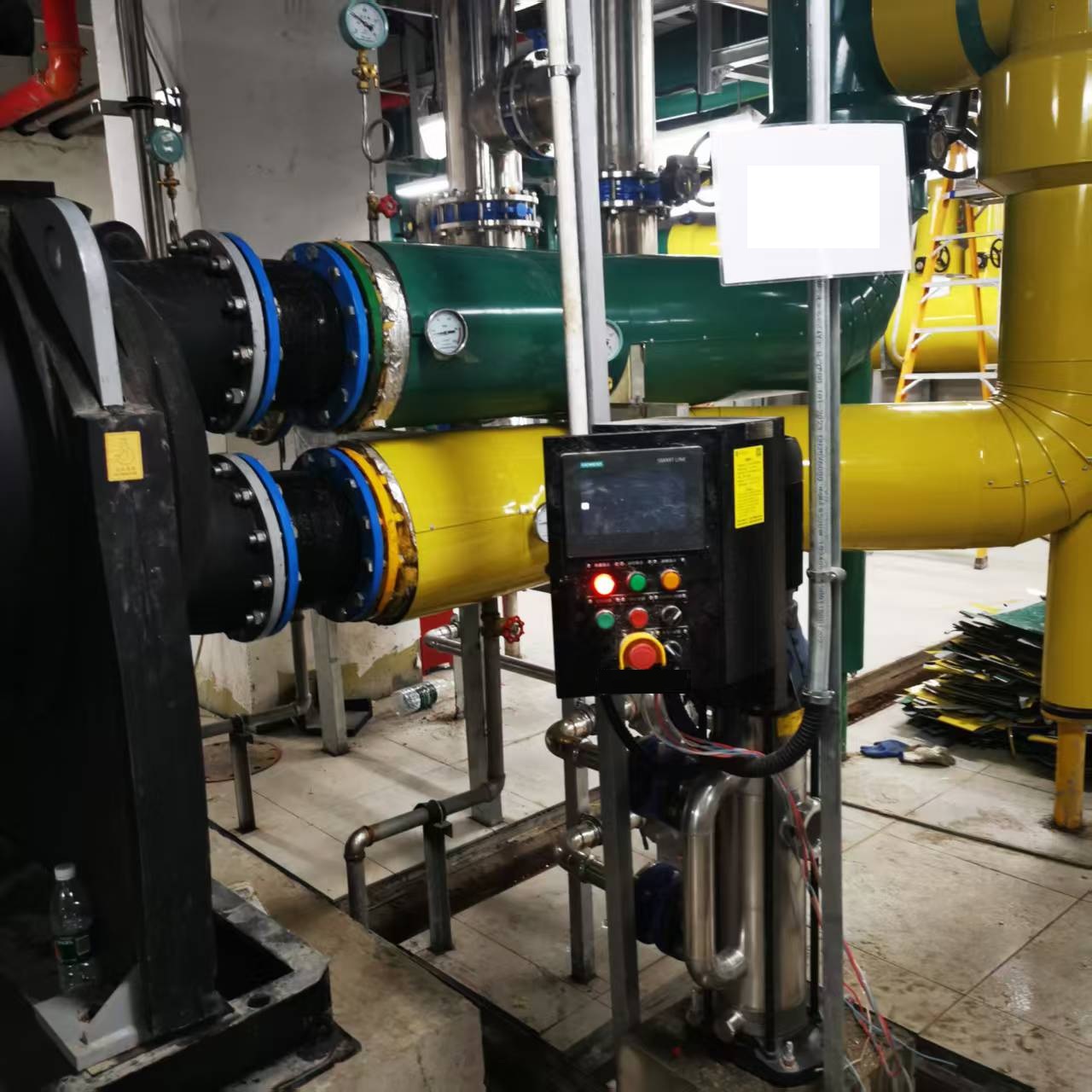
Key Benefits for Power Plants
Maintain Turbine Vacuum
Clean tubes keep condenser pressure low, protecting MW output and heat rate.
Avoid Outage Costs
Online cleaning removes the need to shut down for mechanical tube brushing.
Extend Condenser Life
Continuous wiping reduces pitting and corrosion under deposits.
Integrate with DCS/SCADA
Modbus/BACnet links send status directly to the plant control room.
Typical System Configuration
Power-plant ATCS units are built with larger DN300-DN600 collectors and duplex or 316L stainless steel for circulating water. The PLC receives condenser pressure or vacuum signals and can trigger extra cleaning cycles when back-pressure rises.
| Item | Specification |
|---|---|
| Applicable tube ID | 12 – 30 mm (custom up to 45 mm) |
| Ball material | EPDM, oil and seawater resistant |
| Collector material | Carbon steel / 316L SS / Duplex SS |
| Control | Siemens PLC, Modbus/BACnet to BMS |
| Communication | Remote monitoring and alarm feedback |
Frequently Asked Questions
Condenser Fouling and Turbine Heat Rate
In a thermal power station the surface condenser is not an auxiliary — it sets the back-pressure against which the steam turbine exhausts. When tubes foul, the condenser cannot reject heat at the design rate, saturation temperature rises, and turbine back-pressure rises with it. The penalty is not measured in chiller kilowatts; it is measured in heat rate and in megawatts that the turbine cannot produce.
This is why condenser cleanliness in power generation is tracked as a performance parameter rather than a maintenance item. Operators monitor condenser back-pressure, terminal temperature difference and cleanliness factor precisely because the link between tube condition and station output is direct and quantifiable.
The two dominant fouling mechanisms are mineral scale — driven by cooling water chemistry and concentration cycles — and the accumulation of suspended solids and debris, which is especially relevant for once-through systems drawing from rivers, estuaries or the sea. These require different responses: chemistry controls the first, mechanical cleaning addresses both.
Continuous online cleaning keeps the tube surface near its clean condition between planned outages, so the gradual back-pressure creep that would otherwise accumulate over a run is held flat. For a base-load unit, that difference over a twelve-month run is material.
Performance Indicators for Power Condensers
| Indicator | What it tells you | Fouling signature |
|---|---|---|
| Condenser back-pressure | Direct input to turbine output and heat rate | Drifts upward at constant load |
| Terminal temperature difference | Heat-transfer effectiveness of the tube bundle | Widens as deposits build |
| Cleanliness factor | Actual vs design heat-transfer coefficient | Falls below design value |
| Cooling water ΔP | Flow restriction and debris loading | Rises with blockage or deposit |
Power Plant Questions
Is this suitable for once-through seawater condensers?
Yes, with the right specification. Once-through seawater service brings debris, shell and biological growth alongside scale, so screening and collector design receive particular attention. Ball specification is selected for the tube alloy — titanium, Cu-Ni or stainless — and for the debris load expected at the intake.
How does it compare with a taprogge-type system?
The cleaning principle is the same — circulating slightly oversized balls through the tubes. Differences lie in collector design, control philosophy and how ball inventory is managed. We are straightforward about this: if you already operate a system of that type and it is performing, there is no case for replacement on principle. The case arises when the existing system is not holding cleanliness or is causing tube wear.
Can it run through a full fuel cycle between outages?
That is the design intent. Cleaning is continuous and online; the consumable is the ball inventory, which is replenished on a cycle determined by operating hours and water conditions. There is no requirement to take the condenser out of service for cleaning between planned outages.
What do you need to quote?
Condenser surface area and tube details (diameter, length, count, material), cooling water source and quality, circulating water flow, design and current back-pressure or terminal temperature difference, and annual operating profile. Trend data is especially useful — it lets us quantify the current cleanliness gap rather than assume one.
Get a Power Plants ATCS Quote
Tell us your chiller / condenser model, cooling capacity and water quality. We reply within 24 hours with a tailored solution and ROI estimate.
Prefer email? Write to michealzhang969@gmail.com
Related reading
Explore more in our Automatic Condenser Tube Cleaning (ATCS) →