
ATCS for Desalination Plants
Desalination plants use large seawater condensers and heat exchangers. Biofouling and scale raise pumping power, reduce distillate output and increase chemical cleaning frequency.
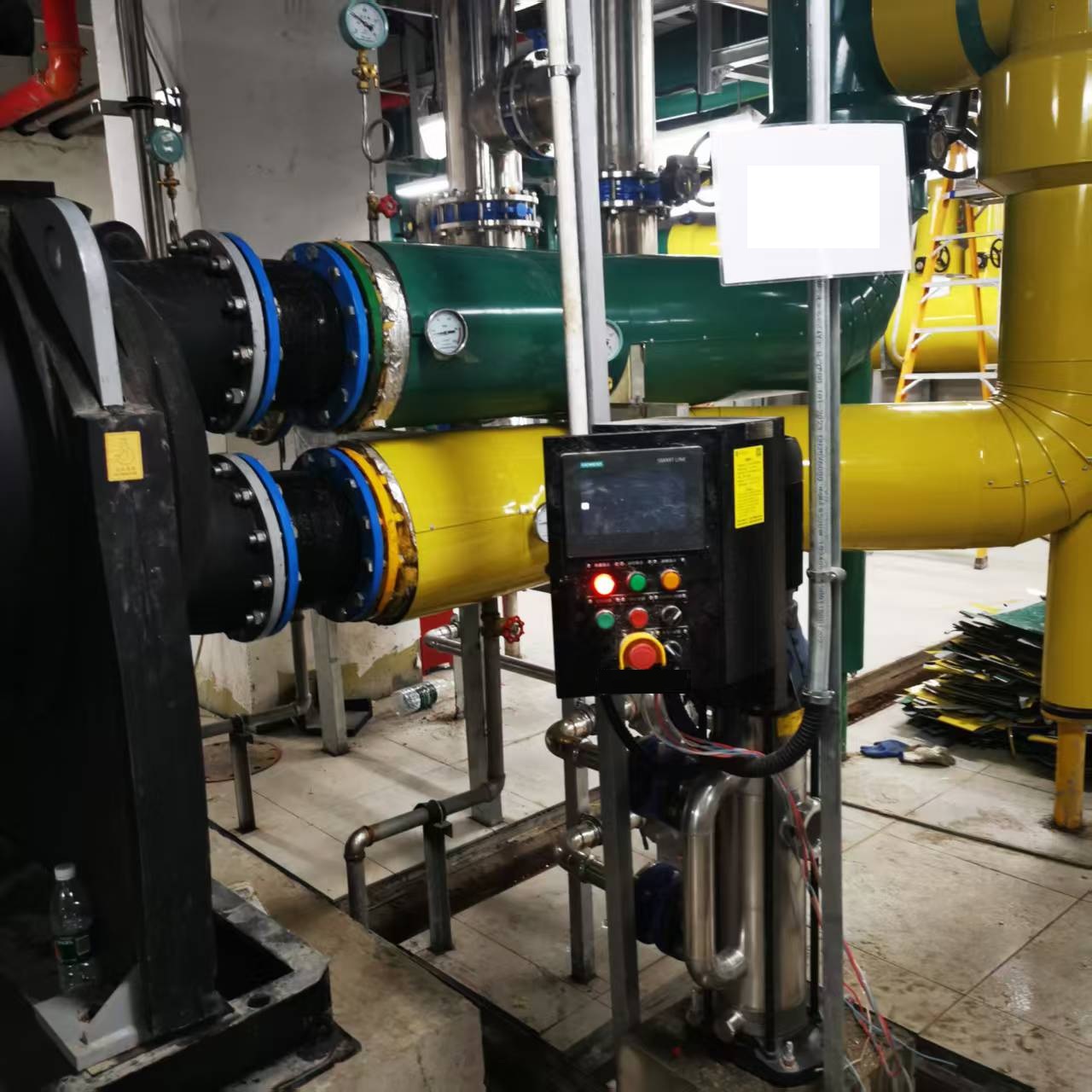
Key Benefits for Desalination
Protect Distillation Performance
Clean tubes maintain heat transfer and production rates.
Lower Chemical Consumption
Reduce biocide and acid cleaning cycles.
Seawater Corrosion Resistance
Duplex stainless and GRP-lined components for long service life.
Maintain Vacuum in MED/MSF
Lower condenser pressure supports efficient thermal processes.
Typical System Configuration
Desalination ATCS units are sized for high-flow seawater intake, with Duplex 2205 or 2507 collectors and ball injection controls tied to plant DCS. We provide material certificates for chloride-rich environments.
| Item | Specification |
|---|---|
| Applicable tube ID | 12 – 30 mm (custom up to 45 mm) |
| Ball material | EPDM, oil and seawater resistant |
| Collector material | Carbon steel / 316L SS / Duplex SS |
| Control | Siemens PLC, Modbus/BACnet to BMS |
| Communication | Remote monitoring and alarm feedback |
Frequently Asked Questions
The Scaling Problem in High-Salinity Service
Desalination service is one of the most aggressive environments for heat-transfer surfaces. Seawater and brine carry high concentrations of calcium, magnesium and sulphate; as water is heated in a condenser or brine heater, the solubility of those salts falls and scale precipitates directly onto the tube wall.
The result is that scaling rates in desalination service are typically far higher than in a fresh-water cooling tower circuit running the same temperature. Where a municipal-water plant might clean annually, a brine-side exchanger can show measurable degradation in a fraction of that time if chemistry and mechanical cleaning are not both in place.
The economics compound this. Taking a desalination train offline is expensive in lost production, not just in maintenance labour, and the downstream membranes are sensitive to upstream upsets. A fouled pre-treatment heat exchanger that drifts out of its temperature window does not only cost energy — it can affect membrane performance and cleaning frequency.
Continuous cleaning addresses the part of the problem chemistry cannot: the deposit that has already formed. In high-salinity service this matters more, not less, because the interval between deposit formation and deposit becoming hard and adherent is short. Wiping the tube while the layer is still soft is far easier than removing it later.
Where Cleaning Is Applied in a Desalination Plant
| Location | Fouling mechanism | Cleaning approach |
|---|---|---|
| SWRO pre-treatment exchangers | Biofilm + particulate | Continuous online cleaning |
| Brine condensers / heaters | Calcium sulphate & carbonate scaling | Online cleaning + chemistry control |
| Power / utility condensers on site | Seawater biofouling + debris | Online cleaning with screening |
| Process coolers | Mixed, depends on stream | Assessed case by case |
Material compatibility is a first-order consideration here: titanium, Cu-Ni and high-grade stainless each behave differently with sponge ball cleaning, and seawater service usually dictates the tube alloy before cleaning is even considered. We confirm ball specification against the tube material, not the other way round.
Desalination Questions
Does online cleaning work in seawater service?
Yes, and seawater is one of the established applications. The specification differs: ball material and hardness, collector screen design and materials of construction must all be selected for chloride exposure and high biological load. Debris screening upstream matters more in seawater than in tower water.
Will it damage titanium or Cu-Ni tubes?
Sponge balls are softer than any tube alloy in normal use, including titanium and copper-nickel. The risk is not abrasion from a correctly specified ball; it is a worn or incorrectly sized ball that has stopped cleaning and started behaving like a foreign object. Following the replacement cycle removes that risk.
How does this interact with our antiscalant dosing?
They are complementary rather than competing. Antiscalant keeps salts in solution so they do not precipitate; mechanical cleaning removes whatever precipitates anyway, plus the biofilm that antiscalant does not address. Plants frequently find that with continuous cleaning in place they can optimise the dosing programme rather than simply adding to it.
Can it be installed without stopping the train?
The piping connections for injection and collection generally require the exchanger to be isolated, so installation is scheduled within a planned maintenance window rather than performed live. Once installed, however, all subsequent cleaning is online — the shutdown is a one-time event, not a recurring one.
Get a Desalination ATCS Quote
Tell us your chiller / condenser model, cooling capacity and water quality. We reply within 24 hours with a tailored solution and ROI estimate.
Prefer email? Write to michealzhang969@gmail.com
Explore more in our Automatic Condenser Tube Cleaning (ATCS) →