
How Automatic Condenser Tube Cleaning Works
A simple, continuous cycle that keeps every condenser tube clean while the plant runs — no chemicals, no shutdowns, no manual brushing.
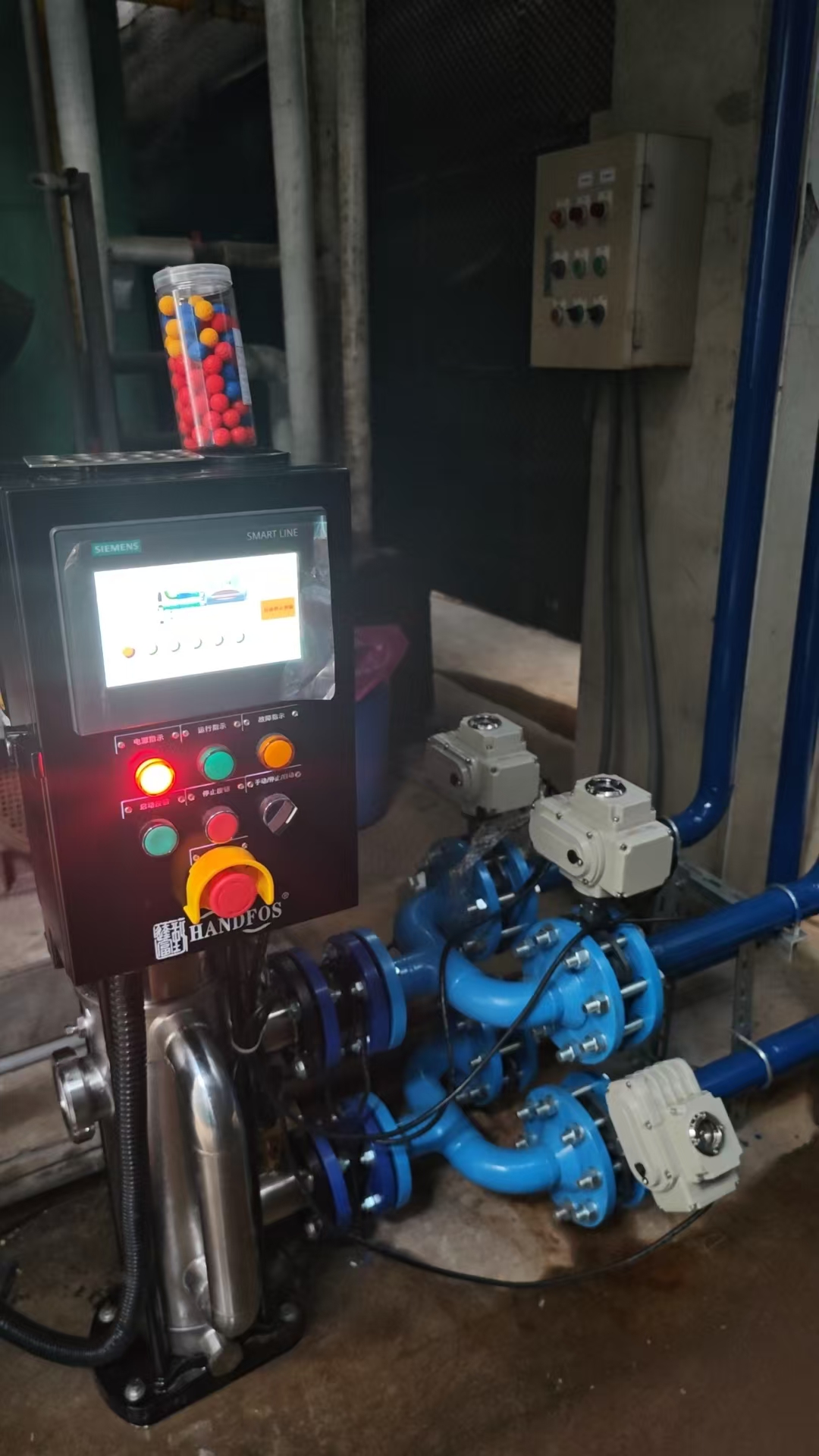
The PLC controller schedules and monitors every cleaning cycle.
The 4-Step Cleaning Cycle
Inject
The PLC signals the injection pump to feed balls into the condenser inlet water box.
Pass
Cooling water carries balls through every tube. Slightly oversized balls wipe the inner wall.
Collect
A ball trap at the outlet recovers balls while letting cleaned water continue to the cooling tower.
Return
Balls are returned to the injection reservoir and the cycle repeats automatically.
System Components & Their Roles
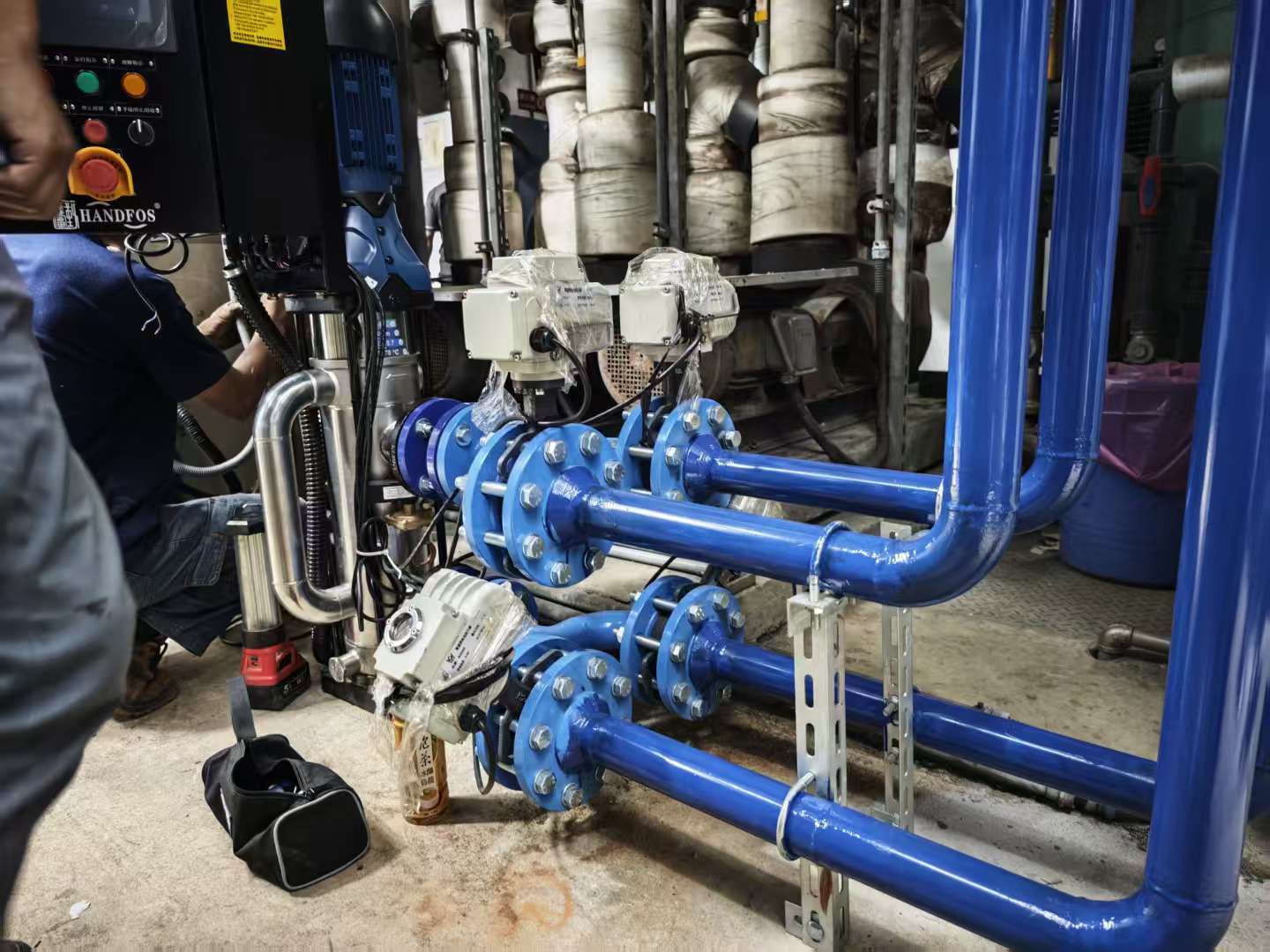
Ball collection piping with motorized isolation valves.
- Ball injection pump / hopper — feeds the correct ball count into the condenser inlet.
- Ball collector / strainer — separates balls from outlet flow and sends them back.
- Motorized valves — direct water flow between normal operation and cleaning mode.
- PLC + HMI panel — sets schedules, monitors cycles and reports alarms to BMS.
- Sponge rubber balls — the cleaning medium, sized to each tube ID.
Why Continuous Cleaning Beats Periodic Cleaning
Manual or chemical cleaning removes fouling only after performance has already dropped. By the time you notice higher power bills, tubes may already have permanent pitting or scale. ATCS prevents fouling from accumulating in the first place, so heat-transfer surfaces stay at design condition every hour of every day.
Frequently Asked Questions
System Specifications
The same continuous cycle applies across condenser sizes and industries. The design envelope below is confirmed during system sizing:
Integration with Plant Controls
The PLC manages injection, collection and recirculation on a fixed schedule or a differential-pressure trigger, and reports alarms to your BMS. For multi-unit sites, the same controller logic scales to each condenser, and a remote-monitoring layer lets a single operator watch cycle counts, ball-loss alarms and cleaning history across the plant. Because the system interfaces only with the cooling-water loop, it does not touch rotating equipment or process controls.
Continuous vs. Manual & Chemical Cleaning
Manual brushing / lancing
Effective but offline; tubes re-foul within days, so most of the year runs at a penalty.
Chemical cleaning
Good for heavy scale but adds dosing, handling and disposal; still a periodic outage.
Continuous online (ATCS)
No shutdown, no chemicals; holds cleanliness at design and keeps energy use minimal.
Want the numbers for your unit? Send the condenser model, cooling capacity and water quality — we return a sized configuration and a 24-hour ROI estimate.
Get a Free ATCS Sizing Quote
Tell us your chiller / condenser model, cooling capacity and water quality. We reply within 24 hours with a tailored solution and ROI estimate.
Prefer email? Write to michealzhang969@gmail.com
{“@context”:”https://schema.org”,”@type”:”FAQPage”,”mainEntity”:[{“@type”:”Question”,”name”:”How do sponge rubber balls clean the inside of condenser tubes?”,”acceptedAnswer”:{“@type”:”Answer”,”text”:”Each ball is 1-2 mm larger than the tube inner diameter. As cooling water carries it through the tube, the ball compresses and wipes the full circumference, removing biofilm, silt and soft scale before deposits harden.”}},{“@type”:”Question”,”name”:”How does the system know when to inject balls?”,”acceptedAnswer”:{“@type”:”Answer”,”text”:”The PLC controller can run on a daily schedule (typically 2-4 cycles per day), by differential pressure trigger, or by external BMS command. Alarms are sent when ball loss exceeds the set limit.”}},{“@type”:”Question”,”name”:”Where does the system connect to the condenser?”,”acceptedAnswer”:{“@type”:”Answer”,”text”:”Two sets of nozzles are added to the existing condenser water boxes: an injection nozzle near the inlet and a collection nozzle at the outlet. No internal condenser modification is required.”}},{“@type”:”Question”,”name”:”What happens to the balls after cleaning?”,”acceptedAnswer”:{“@type”:”Answer”,”text”:”A ball collector/strainer at the outlet separates balls from the water stream and returns them to the injection reservoir, ready for the next cleaning cycle.”}},{“@type”:”Question”,”name”:”Does ATCS affect condenser flow or pressure drop?”,”acceptedAnswer”:{“@type”:”Answer”,”text”:”The collector and piping are sized to keep additional head loss minimal — typically below 0.5 m water column. In many retrofits the pump head margin already covers it.”}}]}