
Chemical Dosing System
Automated chemical dosing skid for corrosion inhibition, scale control and biocide treatment in open and closed cooling water circuits. Built for reliability, accurate metering and simple integration with your existing water treatment program.
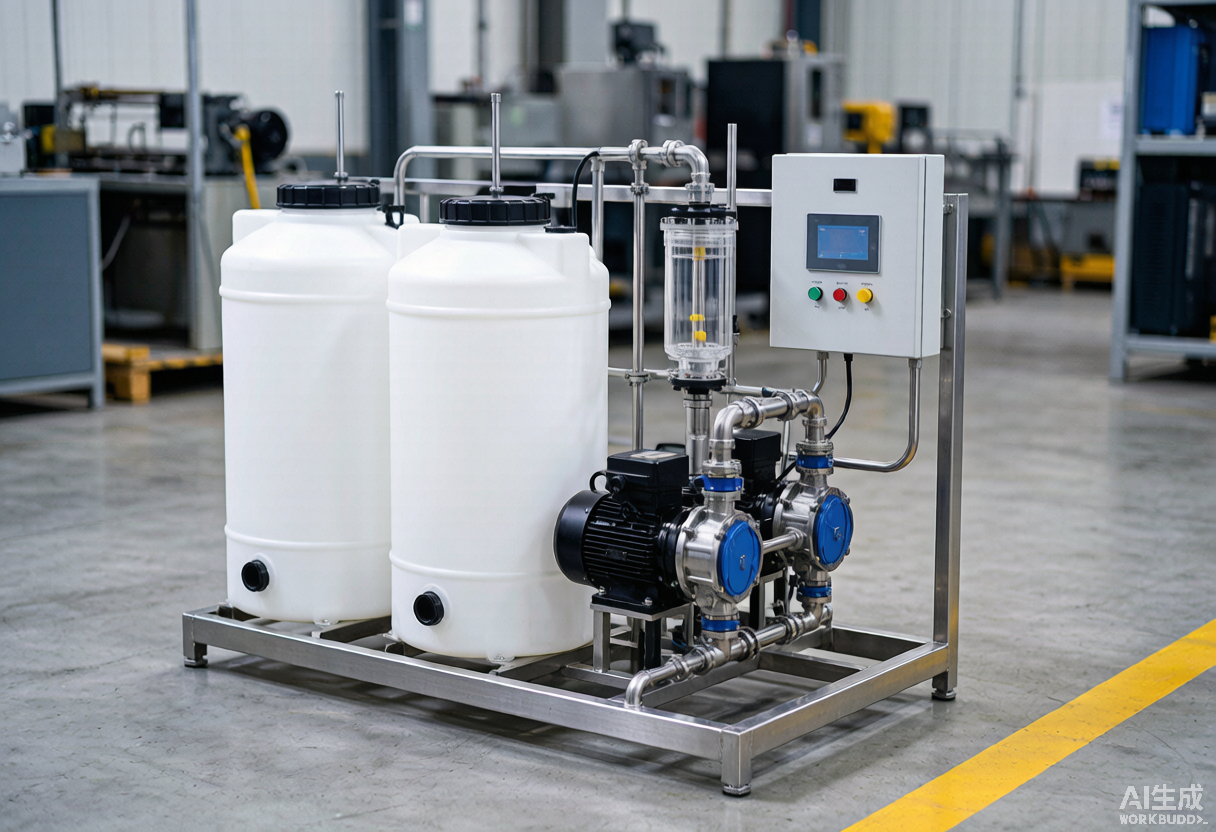
Chemical dosing skid for cooling water treatment (AI-generated placeholder).
What a Chemical Dosing System Does
Cooling water chemistry drifts constantly with evaporation, make-up quality and contamination. Without controlled dosing, corrosion, scaling and microbiological growth reduce heat transfer, damage pipework and force unplanned maintenance.
Our chemical dosing skid injects the right amount of treatment chemical at the right point in the circuit — continuously or on demand. Metering pumps, day tanks, mixers and online sensors are packaged on a single skid with a PLC touchscreen, so operators see flow rates, tank levels and alarm status at a glance.
Key Components & Capabilities
Metering Pumps
Positive-displacement or diaphragm pumps with stroke/speed control for accurate dosing across a wide flow range.
Chemical Day Tanks
PE or stainless tanks with level switches, agitation and low-level alarms to prevent run-dry.
Online Sensors
Optional conductivity, pH, ORP and corrosion-rate probes close the loop on automatic blowdown and dosing.
PLC Touchscreen
Siemens-based HMI with setpoint adjustment, trend logging and Modbus/BACnet integration.
Typical Applications
District Cooling
Corrosion and scale control for large central chiller plants.
Power Plants
Biocide dosing for cooling towers and condenser water circuits.
Data Centers
Closed-loop inhibitor dosing for chilled-water systems.
Industrial HVAC
pH and hardness control for open cooling towers.
Petrochemical
Custom chemical packages for aggressive cooling water.
Desalination
Antiscalant and biocide dosing for SWRO and brine circuits.
Part of the HyApexFlow Water-Treatment Suite
This system works with our automatic condenser cleaning and chemical control products to keep cooling-water circuits efficient, clean and stable.
- ATCS Online Tube Cleaning
Keeps condenser tubes clean without shutdown - Chemical Dosing System • (this system)
Corrosion, scale & biocide control - Constant Pressure Make-up
Stable loop pressure & automatic make-up - AI Integrated Water Treatment
One dashboard for cleaning, dosing & pressure
Request a Chemical Dosing Skid Quote
Tell us your chiller / condenser model, cooling capacity and water quality. We reply within 24 hours with a tailored solution and ROI estimate.
Prefer email? Write to michealzhang969@gmail.com
Sizing & Engineering a Chemical Dosing Skid That Actually Holds Setpoint
How a properly matched dosing system keeps corrosion, scale and biocide inside target — and why bad sizing costs more than the skid itself.
A chemical dosing system for cooling water is a skid-mounted package of metering pumps, day tanks, calibration columns, piping, instrumentation that injects corrosion inhibitor, scale inhibitor, biocide and (optionally) dispersant into the recirculating loop at controlled rates. The job sounds simple — deliver X ppm of chemical Y into the water — but in practice the dosing rate must track make-up flow, cycles of concentration, holding-time index and biological loading; miss any one and the chemistry drifts outside its Langelier / Ryznar stability window, with scale, pitting or biofilm as the result. Across our installed base a properly sized skid holds conductivity within ±5% of setpoint and corrosion rates below 3 mpy, versus open-loop operation where corrosion often runs 8–15 mpy.
Dosing skid selection starts with the cooling-tower mass balance: a tower at 35 °C wet-bulb, evaporating about 1.6% of circulation per 10 °C of cooling range, concentrates dissolved solids two to four times in a typical 4-cycle tower. The dosing pump stroke must be sized for 120% of peak make-up, not the average, so a heat-wave or a system flush does not starve the inhibitor. For a 1,000 m³/hr circulation at 4 cycles, peak make-up is around 50 m³/hr — the skid should deliver at least 60 L/hr of inhibitor to maintain 30 ppm in the bulk water.
Pump type matters: solenoid-driven diaphragm pumps give repeatable low-volume dosing (0.5–15 L/hr) for inhibitor and biocide stroke work; motor-driven peristaltic or hydraulic-diaphragm pumps handle higher rates and viscous polymers; pneumatic pumps suit hazardous-area installations where any electric spark is unacceptable. Calibration columns on each pump suction let the operator verify flow against the design number quarterly without disconnecting piping — the difference between a system you can actually audit and one that just looks good on paper.
Control logic is where most cheap skids fail. The skid needs to read make-up water flow (magmeter on the make-up line) and use it to scale the inhibitor pump stroke proportionally — a fixed-rate timer-driven pump will under-dose during high make-up (a heat wave, a leak repair) and over-dose in winter, wasting chemical and fouling heat exchangers. Biocide dosing is typically scheduled (slug-fed once or twice weekly) rather than continuous, but the trigger should still come from the BMS so log entries align with cooling-load data. Conductivity on the bleed line drives automatic blowdown, which in turn keeps cycles of concentration stable and reduces chemical consumption 10–20%.
Day-tank sizing: 5–7 days of average consumption gives the maintenance team time to refill without stockout. A 1,000 m³/hr tower typically uses 30–60 L/day of inhibitor blend; a 200 L PE day tank is a good standard. Poly tanks are standard for most blends, but check chemical compatibility — some biocides (especially chlorine-dioxide precursors) need HDPE or PP-lined tanks, and acidic cleaners cannot share a tank with alkaline inhibitors. Bunded containment — typically 110% of the largest tank volume — is required in most jurisdictions and is the cheapest insurance against a single spill turning into a six-figure soil-remediation event.
Where the skid sits in the plant matters. The chemical room should be ventilated (6–12 air changes/hr for chlorine-based biocides), bunded, away from plant rooms where sparks are possible, and close enough to the injection point that suction lift on the pumps stays inside the manufacturer’s curve (typically <3 m vertical for diaphragm pumps). For multi-tower plants, a single skid with multiple pump heads feeding each tower in parallel is usually cheaper than one skid per tower, and centralises the chemical inventory.
Operation is largely hands-off: the operator tops up the day tanks weekly, checks calibration monthly, and the BMS logs every stroke, every make-up event, every blowdown cycle. The bigger gains come from coupling the skid to plant analytics — if the BMS sees conductivity drift or corrosion rate tick up, the dosing recipe can be adjusted remotely, often before the operator notices on the next round. For plants without an ATCS retrofit, the dosing skid alone delivers a measurable 10–30% improvement in heat-exchanger cleanliness and a comparable reduction in unscheduled maintenance, because the inhibitor is reaching the loop at the right rate instead of either starving or overdosing it.
Sizing a dosing skid starts with the cooling-tower mass balance and ends with the chemical room layout. We size each pump for 120% of peak make-up, hold 5–7 days of day-tank reserve, and verify suction lift against the diaphragm curve — the three numbers that decide whether the skid actually holds setpoint or drifts.
Operation is largely hands-off: weekly top-up of day tanks, monthly calibration check, BMS logging of every stroke and make-up pulse. The bigger gains come when the skid feeds the plant analytics layer — conductivity drift and corrosion-rate trends trigger recipe tweaks before an operator notices on the next round.
Common failure modes on poorly-sized skids:
- Starved inhibitor during heat-wave make-up surges — scale blooms on heat exchangers within weeks
- Fixed-rate pumps over-dosing in winter, fouling tower fill and wasting chemical
- Chemical-room ventilation below 6 ACH triggers corrosion inside skid piping — a hidden 5-year cost
- Day-tank capacity under 3 days — every stockout drops corrosion protection to zero
Send us your tower size, make-up rate and water analysis — we return a sized skid specification with pump curves, day-tank sizing and a draft BMS interface.
Related reading
Related Verified Case Studies
See the HyApexFlow automatic condenser tube cleaning system (ATCS) proven in the field:
Frequently Asked Questions
What does a chemical dosing system control?
It automates injection of corrosion inhibitors, scale inhibitors and biocides into cooling and chilled-water loops to keep LSI, microbiological counts and metal loss within specification.
Chemical dosing for chilled water vs cooling tower – what is the difference?
Closed chilled-water loops need mainly corrosion and biocide control because there is little evaporation. Open cooling towers need scale, biocide and blowdown control because evaporation concentrates dissolved solids.
Is it automatic or manual?
HyApexFlow skids are automated: metering pumps, ORP/pH/conductivity probes and a controller hold setpoint without operator intervention.
How is a dosing skid sized?
By loop volume, make-up rate, target residual and water chemistry. We size pump capacity and tank volume from these parameters on quote.
Can it integrate with the make-up and expansion system?
Yes – it is part of the HyApexFlow water-treatment suite and is often specified alongside the constant-pressure water make-up system.
Related Dosing Solutions
- Boiler Water Dosing System
- Industrial Circulating Water Dosing
- Wastewater Treatment Dosing System
- RO Pretreatment Dosing System
- Chilled Water System Dosing Guide
- Cooling Tower Dosing Best Practices
- Closed Loop HVAC Dosing
- Open Circuit Cooling Dosing
Selection and Cost Guides
Dosing and make-up selection, automatic vs manual savings, and lifecycle cost.
- Chemical Dosing System Selection Guide
- Constant Pressure Make-up Selection Guide
- Automatic Dosing Cost Savings
- Cooling System Lifecycle Cost
Related Guides and Case Studies
Explore dosing and make-up selection, cost savings and field case studies.
- Condenser Tube Cleaning in the Philippines
- Condenser Tube Cleaning in Egypt
- Condenser Tube Cleaning in Oman
- Case Studies
What Is a Chemical Dosing System?
A Chemical Dosing System automatically injects precise doses of scale inhibitors, corrosion inhibitors, and biocides into cooling-water or chilled-water loops. It controls scaling, corrosion, and biofouling to protect heat exchangers and extend equipment life with minimal manual intervention.
Chemical Dosing vs Alternatives
| Approach | Automation | Chemical Dependency | Best For |
|---|---|---|---|
| Automatic chemical dosing | Full | Required | Scale/corrosion/bio control at lowest labor |
| Manual dosing | None | Required | Small systems, low frequency |
| Chemical-free treatment | Full | None | Environmental-sensitive sites |
| ATCS (physical cleaning) | Full | Low | Condenser tube fouling specifically |
Frequently Asked Questions
- What chemicals are typically dosed?
- Scale inhibitors, corrosion inhibitors, and biocides (oxidizing or non-oxidizing) dosed proportionally to makeup water and cycle concentration.
- Can dosing be combined with ATCS?
- Yes. Dosing controls bulk water chemistry while ATCS removes tube-side deposits — the two are complementary, not competing.
- How is dosing controlled?
- Modern systems use conductivity/ORP/pH probes with proportional metering pumps for closed-loop, demand-based dosing.
Biocide Dosing & Corrosive-Liquid Dosing for Chilled Water Systems
Beyond scale and corrosion control, our chemical dosing systems handle biocide dosing and aggressive chemistries — including dosing systems for corrosive liquids such as oxidizing and non-oxidizing biocides, acids and specialty inhibitors. Each chemical dosing tank for chilled water systems is built from compatible materials (PE, PP, PVDF or 316L) matched to the dosed media, with leak-safe, secondary-contained skids. HyApexFlow supplies automatic chemical dosing systems and dosing skids as a manufacturer and integrator for HVAC, industrial and process cooling loops.
Chemical Dosing Guides & System Comparisons
Learn more about biocide, scale-inhibitor and corrosion-inhibitor dosing, dosing pump selection and water-treatment strategy:
Related: Products.
Related: Data Center Cooling Solutions — see how ATCS, CDU, chemical dosing and constant-pressure makeup work together.
Frequently Asked Questions
What is a chemical dosing system?
An automated skid that injects precise amounts of treatment chemicals — corrosion inhibitor, scale inhibitor, and biocide — into cooling or chilled-water loops, controlled by pH, ORP, conductivity, or flow signals.
Why dose chemicals into chilled water systems?
To control corrosion, scaling, and microbiological growth that otherwise foul heat exchangers, raise energy use, and cause unscheduled downtime. Dosing keeps the loop within its designed water-quality window.
How accurate is automatic chemical dosing?
Metering pumps hold ±0.5% repeatability. A PLC modulates dose to actual demand (feedback control) instead of fixed timers, cutting chemical consumption and discharge.
Which parameters does a dosing skid control?
Commonly pH, ORP (oxidation-reduction potential for biocide efficacy), conductivity (blowdown control), and sometimes free-chlorine or corrosion-inhibitor residual.
How do you size a chemical dosing skid?
Sizing is based on system volume, make-up water rate, and the target chemical residual recommended by your water-treatment programme — typically specified by a treatment specialist per site.
See how chemical dosing fits into an integrated cooling-water solution →
Chemical Dosing System — Key Parameters
| Parameter | Typical Range / Option |
|---|---|
| Dosing accuracy | ±0.5% repeatability (metering pumps) |
| Control signals | pH, ORP, conductivity; flow pacing optional |
| Chemicals handled | Corrosion inhibitor, scale inhibitor, biocide |
| Control unit | PLC-driven, feedback control on real demand |
| Operation | Continuous, unattended; alarm & interlock ready |
Automatic Dosing vs Manual Dosing
| Criterion | Automatic skid | Manual dosing |
|---|---|---|
| Accuracy | ±0.5%, feedback-controlled | Operator-dependent |
| Chemical consumption | Optimized to demand | Often over-dosed |
| Response to load change | Real-time (pH/ORP feedback) | Delayed (test & adjust) |
| Safety | Closed handling, interlocks | Frequent manual contact |
| Consistency | 24/7 within water-quality window | Shift-dependent |
Applications & Further Reading
- Cooling-tower water treatment — scale, corrosion & biocontrol
- How a dosing skid works — pumps, signals & control loop
- Selection guide — sizing by system volume & make-up rate
- Commercial-complex cooling-tower case study
Chemical Dosing Pump Sizing Reference
Use the make-up + blowdown flow and the target residual to size the metering pump. A practical estimate:
Pump capacity (L/h) ≈ Target residual (ppm) × (Make-up + Blowdown) (m³/h) ÷ 1000
| Parameter | Basis | Typical Range |
|---|---|---|
| Target inhibitor residual | Water chemistry & metallurgy | 20–50 ppm |
| Blowdown rate | From cooling tower operation | Site measured |
| Make-up rate | Evaporation + drift + blowdown | Site measured |
| Metering pump capacity | Per formula above | 0.5–10 L/h (skid dependent) |
| Day tank volume | ≥ 1 week of dosing | 100–1000 L |
Every HyApexFlow skid is engineered against the plant’s actual circulating volume and water report — request a sizing sheet with your inquiry.