
Constant Pressure Water Make-up System
A pressurised make-up and expansion control skid that keeps closed-loop HVAC systems stable. Maintains set pressure, reduces air ingress and protects pumps and heat exchangers from pressure shocks.
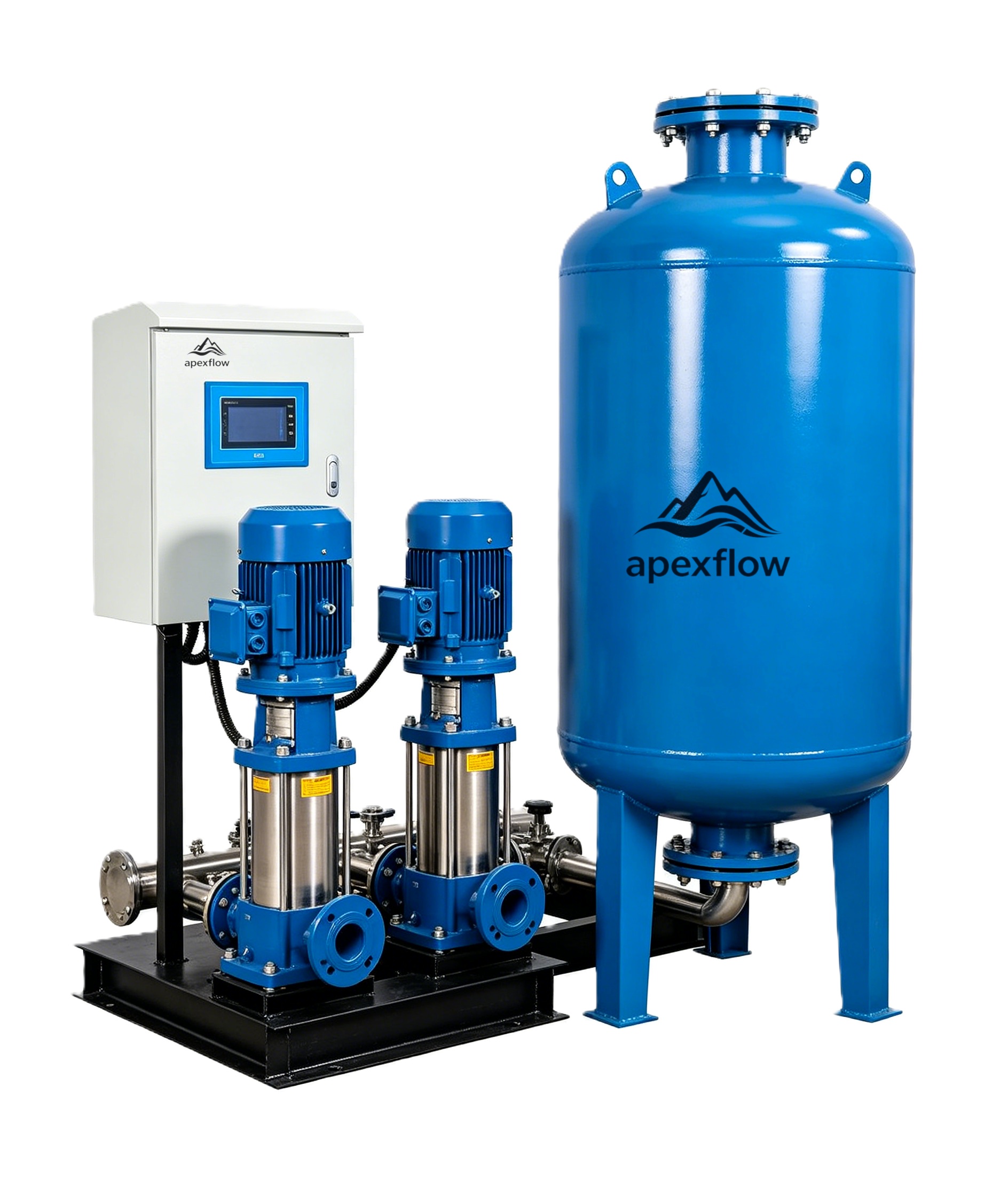
HongYue ApexFlow constant pressure water make-up system with dual-logo expansion tank.
Why Closed Loops Lose Pressure
Closed chilled-water and hot-water circuits lose small amounts of water through valves, seals and vents over time. Without controlled make-up, pressure drops, air enters the system, cavitation begins and pump performance falls.
Our make-up unit senses system pressure and adds treated water only when needed. A bladder expansion tank absorbs thermal expansion, while the pump set delivers make-up water against the required static head.
Key Features
Variable-Speed Pump Set
Multistage centrifugal pumps with inverter control for quiet, energy-efficient pressure maintenance.
Bladder Expansion Tank
Absorbs thermal expansion and protects pressure relief devices from frequent cycling.
Pressure Transducers
Real-time pressure feedback with high/low alarms and automatic pump alternation.
Pre-Treatment Options
Optional softening, filtration and chemical dosing modules integrated on the same skid.
Typical Applications
District Cooling
Stable pressure across long distribution networks.
Commercial HVAC
Make-up for high-rise chilled-water loops.
Data Centers
Protect critical chilled-water circuits from pressure loss.
Industrial Process
Pressurised water supply for closed cooling loops.
Power Plants
Auxiliary closed-loop cooling water pressure control.
Marine & Offshore
Compact skids for engine room HVAC systems.
Part of the HyApexFlow Water-Treatment Suite
This system works with our automatic condenser cleaning and chemical control products to keep cooling-water circuits efficient, clean and stable.
- ATCS Online Tube Cleaning
Keeps condenser tubes clean without shutdown - Chemical Dosing System
Corrosion, scale & biocide control - Constant Pressure Make-up • (this system)
Stable loop pressure & automatic make-up - AI Integrated Water Treatment
One dashboard for cleaning, dosing & pressure
Why Closed Loops Lose Pressure — and What That Costs Operators
Every closed chilled-water or condenser-water loop loses pressure over time. Some losses are visible — a pump seal weeping, a small drip from a flanged joint — but the more common ones are not. Evaporation from open cooling towers, the slow seepage at expansion-vessel bladders that have lost elasticity, and the modest but continuous losses through bleed-off and chemical-dosing pumps all add up. In a mid-sized district-cooling loop running 3,500 TR, the cumulative loss can be 1.5–3.0 % of the loop volume per day.
When static head drops, the first thing operators notice is the relief valve cycling, then the expansion tank level falling, then — if nothing is done — the pumps losing their NPSH margin and cavitating. By the time cavitation noise is audible, the bearings are already taking damage. A make-up system is normally the simplest fix, but the choice between on-off solenoid metering, variable-speed pump with pressure transducer, and a bladder-equipped stabiliser changes the operating profile significantly.
The constant-pressure variant keeps the loop at a defined setpoint (typically 1.0–2.5 bar, project-specific) regardless of how the load above it behaves. It does this with a pressure transducer feeding a variable-speed pump, paired with a small break-tank sized to the local water-supply requirements and backflow-prevention standard. The result is stable differential pressure across the terminals, no relief-valve cycling, and a slower bleed rate because the system is no longer being topped up reactively.
In practice the energy saving compared with a properly sized but unsupplemented system is modest; the real saving is equipment life. Pump bearings, seal faces, valve stems and control-valve actuators all last longer when they are not working against a pressure profile that drifts by a bar over the course of a season. For plant rooms that already run tight on operating hours, that is usually the more decisive argument.
Selection Parameters We Use on a HyApexFlow Quote
| Parameter | Typical range / value | Why we ask |
|---|---|---|
| Loop type | Chilled water / condenser water / hot water | Determines static-head calculation and material compatibility |
| Loop volume | 5 m³ – 80 m³ typical project range | Sizes break-tank capacity and pump headroom |
| Setpoint pressure | 1.0 – 2.5 bar (system-side) | Set by building static head + 0.5–1.0 bar margin |
| Make-up water source | Potable / softened / RO — per local water-quality report | Drives break-tank backflow spec and pre-treatment requirement |
| Daily top-up rate | 0.5 – 5 % of loop volume / 24 h | Sets pump duty and storage tank sizing |
| Power & control | 220 V / 1-ph or 380 V / 3-ph; 4–20 mA or Modbus | Matches plant BMS / SCADA integration requirement |
Send the parameters above with your chiller / condenser model numbers and water-quality report. We reply within 24 hours with a sized configuration and a delivered-cost estimate.
Make-up System Questions, Answered
Does a constant-pressure unit replace the expansion tank?
No — they serve different functions. The expansion tank absorbs thermal-volume changes; the make-up unit replenishes water losses. In most plant rooms both are required, with the make-up line discharging into the expansion tank rather than directly into the loop.
Can it be retrofit to an existing loop without draining?
Yes, in nearly all cases. The break-tank and pump skid is installed on a bypass with an isolation valve arrangement; the loop stays pressurised throughout. Typical installation requires two hot-tapping points on the common return header and a 220 V / 380 V supply.
What is the maintenance interval?
Six-monthly inspection (pressure transducer calibration check, seal inspection, strainer cleaning) and annual servicing (pump bearing condition, valve-actuator cycling test). Consumables are standard off-the-shelf items; no proprietary spares are required.
Does it handle glycol / brine loops?
Yes, with material upgrades on the seal faces and pump elastomers. Tell us the concentration (ethylene glycol, propylene glycol, or calcium chloride brine) when requesting a quote.
Request a Make-up System Quote
Tell us your chiller / condenser model, cooling capacity and water quality. We reply within 24 hours with a tailored solution and ROI estimate.
Prefer email? Write to michealzhang969@gmail.com
What Is a Constant Pressure Water Make-up System?
A constant pressure water make-up system (often called a pressurised make-up and expansion control skid) automatically keeps a stable system pressure and a precise water level in closed-loop HVAC, chilled-water, and cooling-water circuits. Instead of relying on a float valve or an open expansion tank, it uses a variable-speed make-up pump (or a pressure-regulating station) to inject make-up water only when loop pressure falls below the setpoint, holding the circuit inside a tight band of roughly ±0.05–0.1 bar at all times.
How It Works — 4 Steps
- Monitor: pressure transducers track loop pressure continuously (typically every second).
- Detect: when pressure drops below setpoint — caused by leakage or thermal contraction — the controller starts the make-up pump.
- Inject: filtered/softened make-up water is drawn from the supply and injected until pressure is restored to setpoint.
- Expand & hold: excess volume on heating is diverted to the expansion vessel; the controller maintains the pressure band automatically.
Constant Pressure vs. Traditional Make-up Methods
| Method | How It Works | Pressure Stability | Make-up Accuracy | Best For |
|---|---|---|---|---|
| Float valve (traditional) | Open tank + floating ball | Poor — level swings | Low | Small open systems |
| Open expansion tank | Gravity feed from roof tank | Poor in high-rise | Low | Legacy buildings |
| Constant-pressure make-up (this unit) | VFD pump / regulated station, on-demand injection at setpoint | Excellent (±0.05 bar) | High | Chilled water, data centers, high-rise |
| Nitrogen blanketing | Gas cushion keeps loop sealed | Good | Medium | Critical closed loops |
Key Technical Parameters
| Typical Specification Range | |
| Pressure control accuracy | ±0.05 – 0.1 bar |
| Make-up flow | 0.5 – 20 m³/h (model dependent) |
| Inlet (supply) pressure | 1.0 – 6.0 bar |
| Max system pressure | up to 16 bar |
| Pump power (VFD) | 0.37 – 5.5 kW |
| Medium | Clean make-up water (softened recommended) |
Why Choose Constant-Pressure Make-up?
- Closed, pressurised loop — eliminates air ingress, cutting oxygen corrosion and scaling.
- Stable pressure reduces pump cavitation, seal leakage, and valve chatter.
- Automatic & unattended — alarms on abnormal over-make-up, which doubles as early leak detection.
- Water savings — no open-tank overflow loss compared with roof expansion tanks.
Related Resources
- Automatic Condenser Tube Cleaning System (ATCS)
- Automatic Chemical Dosing System
- Chilled Water System Dosing Guide
What Is a Constant Pressure Water Makeup System?
A Constant Pressure Water Makeup System automatically maintains stable system pressure and replenishes water lost to evaporation and leakage in closed-loop HVAC and cooling circuits. It prevents cavitation, air ingress, and pressure tripping without manual top-up.
Makeup / Pressurization vs Alternatives
| Method | Pressure Stability | Automation | Notes |
|---|---|---|---|
| Constant-pressure makeup unit | High | Full | Active make-up + pressurization |
| Manual make-up valve | Poor | None | Labor-intensive, risk of over/under fill |
| Static expansion tank | Medium | None | Passive, limited capacity |
| Pressurization only (no make-up) | Medium | Partial | Needs separate补水 |
Frequently Asked Questions
- Why is constant pressure important?
- Stable pressure prevents pump cavitation and air pockets that destroy heat-transfer efficiency and cause nuisance trips.
- Where is it used?
- Closed-loop chilled-water, heating, and cooling circuits in commercial buildings, district cooling, and industrial plants.
- Does it handle both make-up and pressurization?
- Yes. An integrated unit senses pressure and triggers make-up automatically, holding the setpoint continuously.
Related: Data Center Cooling Solutions — see how ATCS, CDU, chemical dosing and constant-pressure makeup work together.
Frequently Asked Questions
What is a constant pressure water make-up system?
A pressurised make-up and expansion-control skid that holds stable pressure in closed-loop HVAC and chiller systems as water thermally expands and contracts during operation.
Why is a make-up system needed?
Without it, thermal expansion causes pressure spikes and air ingress, which lead to corrosion, pump cavitation, and premature seal failure. The skid absorbs expansion and tops up automatically.
What are the main components?
A make-up pump (or make-up valve), an expansion vessel, a pressure transmitter, and a control panel that maintains the set-point without manual intervention.
Combine make-up control with dosing and ATCS in one engineered package →
Complete the Closed-Loop Water Strategy
Pressurization controls pressure and air ingress; these two units complete the water-treatment picture for a stable, efficient loop:
- Automatic tube cleaning system (ATCS) — continuous condenser cleaning for connected chillers.
- Automatic chemical dosing system — scales and corrosion control across the loop.
Constant Pressure Make-up System — Key Parameters
| Parameter | Typical Configuration |
|---|---|
| Function | Pressure stabilization + automatic make-up + expansion control |
| Core components | Make-up pump, expansion vessel, pressure transmitter, control panel |
| Control | Set-point maintained automatically, no manual intervention |
| Application | Closed-loop HVAC / chiller chilled-water systems |
| Benefit | Less air ingress, less corrosion, fewer pump & seal failures |
Make-up Skid vs Traditional Expansion Tank
| Criterion | Pressurized make-up skid | Open expansion tank |
|---|---|---|
| Pressure stability | Active control to set-point | Passive, varies with temperature |
| Air ingress | Minimized (sealed loop) | Common cause of corrosion |
| Top-up | Automatic on pressure drop | Manual monitoring |
| Equipment protection | Prevents cavitation & seal failure | Limited |
Applications & Further Reading
- Selection guide — sizing by system volume & pressure window
- All applications — where make-up control fits into the plant