
AI Integrated Water Treatment System
A cloud-connected, AI-assisted platform that unifies ATCS, chemical dosing and make-up control in one dashboard. Built to move water treatment from scheduled maintenance to predictive, data-driven operation.
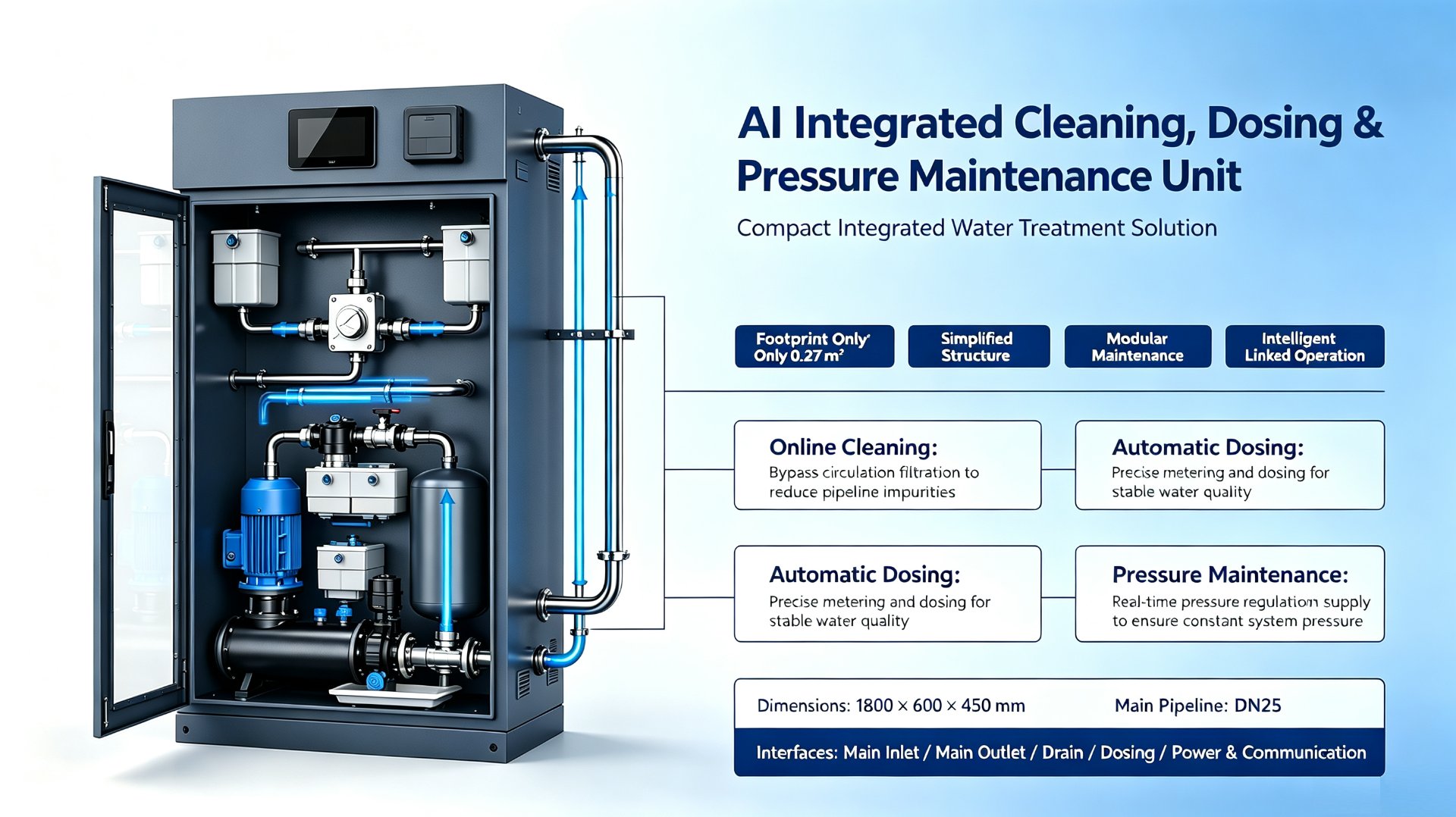
HYATCS AI integrated cleaning, dosing and pressure maintenance unit.
The Vision: One Brain for Cooling Water
Today, ATCS, chemical dosing and make-up units often run as separate islands. The AI Integrated Water Treatment System connects them through a single cloud-native platform that reads sensor data, learns operating patterns and recommends — or automatically adjusts — setpoints for chemical use, cleaning cycles and pressure targets.
This is a roadmap product. We are developing it with input from early field partners and plan to offer it as an upgrade path for existing HyApexFlow installations as well as a bundled option for new plants.
Planned Capabilities
Unified Dashboard
View ATCS status, dosing rates, make-up pressure and water quality in one interface.
Predictive Fouling Alerts
Machine-learning models flag condenser performance drift before energy costs spike.
Automated Chemical Optimisation
Dynamic dosing recommendations based on real-time load, make-up rate and water analysis.
Remote Expert Support
Secure cloud telemetry lets HyApexFlow engineers review trends and advise on tuning.
Roadmap Status
We are currently validating the AI platform architecture and sensor integration with selected field partners. If you operate a large portfolio of chillers or cooling towers and want to participate in early pilots, please contact us.
Q3 2026
Cloud gateway and dashboard prototype
Q1 2027
Pilot deployments with partner sites
Q3 2027
General release and retrofit upgrade kits
Part of the HyApexFlow Water-Treatment Suite
This system works with our automatic condenser cleaning and chemical control products to keep cooling-water circuits efficient, clean and stable.
- ATCS Online Tube Cleaning
Keeps condenser tubes clean without shutdown - Chemical Dosing System
Corrosion, scale & biocide control - Constant Pressure Make-up
Stable loop pressure & automatic make-up - AI Integrated Water Treatment • (this system)
One dashboard for cleaning, dosing & pressure
Why Cooling-Water Chemistry Is Still a Manual Process — and Why That Has to Change
Most plant rooms still dose biocides, scale inhibitors and corrosion inhibitors on a timer or a thumb-rule. The dosing pump runs at the same stroke length whether the cooling tower is at peak load or barely evaporating; whether the recirculating water has just been topped up with fresh RO permeate or has been concentrated by the sun all week; whether the biofilm count is creeping up because of a change in the incoming make-up water or holding steady through a quiet month. The result is over-dosing in some conditions and under-dosing in others, with consequences ranging from wasted chemical spend to accelerated equipment damage.
The chemistry itself is well understood. Cyclotetrasiloxane-based scale inhibitors work, oxidising biocides work, dispersants work. The gap is not in the chemistry — it is in the feedback loop. The dosing pump does not know what just happened in the tower. It runs a programme that was decided by an operator who last looked at a water test three weeks ago.
Closing that gap is the object of an AI-integrated control layer. The necessary inputs already exist on most plant floors: flow meters on make-up and bleed, conductivity probes, ORP sensors, sometimes an inline corrosion probe or a particle counter. They are individually accurate; they are collectively ignored because no one has time to watch six trend lines at once. Adding a control layer that does watch them, correlates them with the chiller load profile, and adjusts the dosing pumps on a continuous basis is the incremental change that moves the whole system from “good chemistry on a good day” to “good chemistry every day”.
This is not hypothetical AI; it is supervisory control with model-predictive logic. The same regime is already deployed in power-plant feed-water chemistry under the umbrella of Industry 4.0 / IIoT. Adapting it to commercial and district-cooling loops is mainly a question of economics — the loop must be large enough that chemical and water savings justify the instrumentation and control cost. That threshold is typically reached around 1,500 TR of cooling capacity; below it, conventional timer-based dosing remains the right answer.
Inputs the AI Layer Reads and Outputs It Adjusts
| Input sensor | What it tells the controller | Output action |
|---|---|---|
| Conductivity probe | Cycles of concentration | Adjusts bleed valve + inhibitor dose |
| ORP / free chlorine probe | Biofilm / microbiological activity | Triggers oxidising biocide pulse only when needed |
| pH probe | Acid demand of the loop | Sulphuric / hydrochloric acid dose adjustment |
| Make-up water flow meter | True daily leakage / evaporation | Trend reporting + leak detection alert |
| Chiller load signal (4-20 mA) | Current demand profile | Forward-looking dose scheduling |
| Inline corrosion probe (optional) | Real-time corrosion rate | Inhibitor blend adjustment |
Most plant floors already have 2–4 of the six instruments installed; the AI layer integrates what you have rather than insisting on a parallel sensor stack. That is also why the economic break-even sits at ~1,500 TR and not at 500 TR.
Water-Treatment Control, Answered
Is this an “AI” product or a real control system?
It is a real industrial controller running model-predictive logic on top of standard cooling-water chemistry. The “AI” label refers to the feedback correlation engine; the chemistry itself is conventional inhibitor / biocide chemistry that has been in use for decades. Nothing exotic is added to the water.
Does it require internet connectivity?
No — edge control is the default architecture. The controller runs locally and stores trend data on board; remote access (Modbus / 4G / Ethernet) is available for operators who want it, but is optional. This keeps the cybersecurity surface to whatever the plant BMS already exposes.
Will it work with our existing dosing pumps?
In most cases yes. The controller outputs 4–20 mA or Modbus setpoints to the existing chemical-feed skid; the pump hardware stays unchanged. A site survey takes about 90 minutes and confirms the integration points before any equipment is delivered.
What does early access involve?
A site survey (loop volume, sensor inventory, BMS integration requirements), a phased rollout plan against your operating calendar, and a reference agreement covering data we can and cannot publish. Early-access projects are scheduled in two slots per quarter.
Request Early-Access Information
Tell us your chiller / condenser model, cooling capacity and water quality. We reply within 24 hours with a tailored solution and ROI estimate.
Prefer email? Write to michealzhang969@gmail.com
Related Resources
- Automatic Condenser Tube Cleaning System (ATCS)
- Automatic Chemical Dosing System
- Constant Pressure Water Make-up System
- FAQ
Related Reading
Understand the HyATCS intelligent water-treatment approach:
Development Roadmap — One Dashboard for the Whole Water Loop
The AI Integrated Water Treatment platform is in R&D phase and unifies three HyApexFlow disciplines in a single cloud dashboard:
- Fouling control — ATCS cleaning-cycle telemetry & trend-based optimization
- Chemical dosing — pH / ORP / conductivity data with dose verification
- Pressure management — make-up & expansion status with leak alerts
Planned release stages: internal pilot → selected customer sites → general availability. Specifications and pricing will be published at launch.