
Automatic Tube Brush Cleaning System
A brush-type online tube cleaner that scrubs condenser and heat-exchanger tubes automatically — with no shutdown. Every tube carries a brush captured in end baskets; a PLC-driven flow-reversal valve sends each brush through its tube on a 4–6 hour cycle, removing fresh and hardened fouling that soft cleaning balls cannot shift.
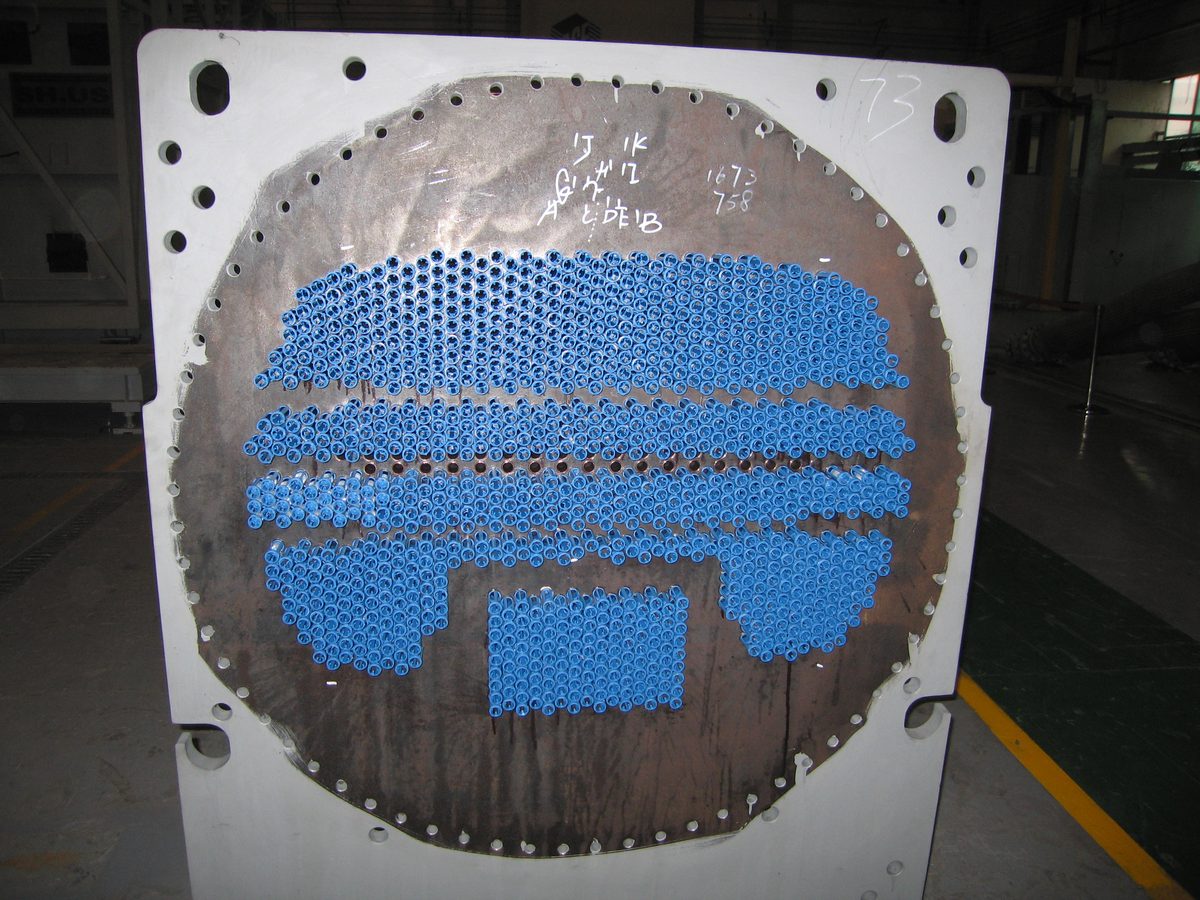
Brush cages installed at the tube sheet of a large chiller condenser — retrofit installation, no shutdown.
What Is an Automatic Tube Brush Cleaning System?
An automatic tube brush cleaning system (also called a brush-type tube cleaner or online brush cleaning system) is an in-tube mechanical cleaning technology for shell-and-tube condensers, evaporators and heat exchangers.
Instead of circulating loose cleaning media through the tubes, a brush-type system installs a brush in every single tube, captured in a basket at each tube end. A four-way flow-reversal valve periodically reverses the cooling-water flow, driving each brush from one end of its tube to the other. The bristles scrub the tube wall mechanically on every pass, then park back in the basket until the next cycle.
Because the brush is captured, nothing is lost into the piping — and because the cleaning action is mechanical scrubbing rather than soft wiping, it can attack deposits that sponge balls simply slide over.
System Components
Brush & Basket Set
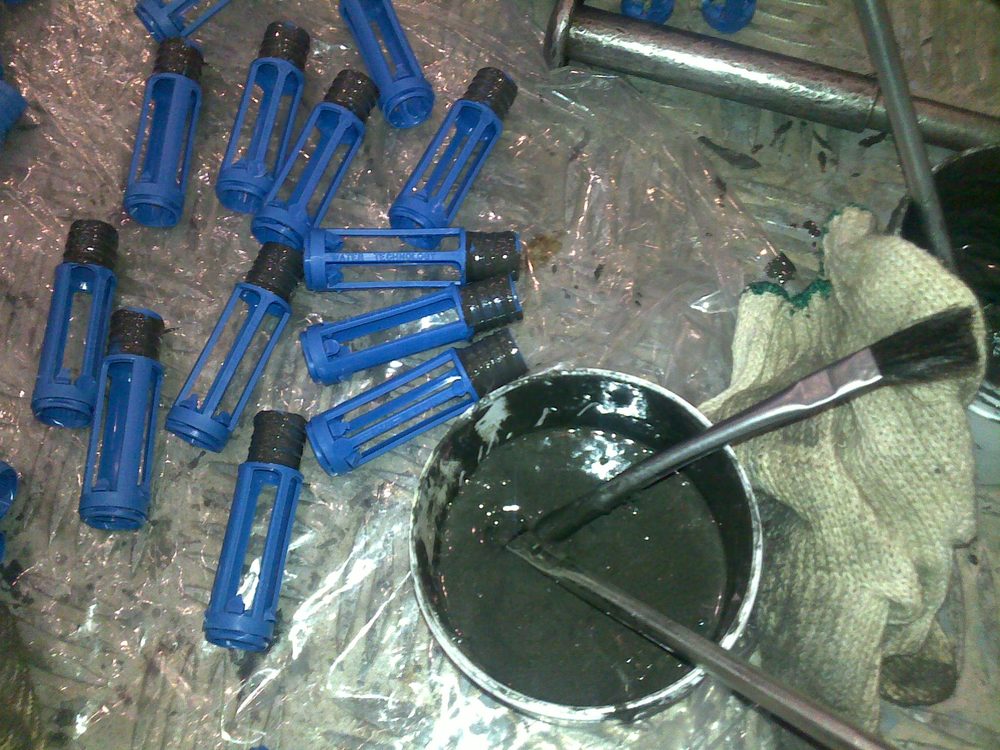
One wear-resistant, anti-fouling bristle brush per tube, sized to the tube inner diameter, held in baskets at both tube ends. Spiral-spring construction keeps bristles snug against the wall; thermal-expansion spring end caps absorb tube growth.
Four-Way Reversing Valve
Electric, pneumatic or hydraulic actuation. Reverses condenser flow so brushes sweep the tubes; a manual bypass allows service without stopping the plant.
PLC Controller
Industrial PLC with color touchscreen: programmable cleaning interval, cycle counter, alarms, standard RS485 for BMS integration, and interlock that stops cleaning when the chiller stops.
How It Works
Four steps repeat automatically, typically every 4–6 hours:
1. Standby
Flow runs normally. Brushes rest in their baskets, outside the main flow path. An electronic flow switch confirms circulation before any cycle starts.
2. Reverse
The PLC actuates the four-way valve, sending cooling water through the tubes in the opposite direction.
3. Scrub
Water pressure pushes every brush through its tube. The bristles mechanically scrub the wall, breaking up scale and biofilm.
4. Park
Brushes arrive at the far baskets and park. Flow returns to normal until the next cycle — no shutdown, no lost media.
Brush Cleaning vs Ball Cleaning: How to Choose
Both are online tube-cleaning technologies that run without shutdown — but they suit different water and fouling conditions.
| Dimension | Brush-type (this page) | Ball-type (HYATCS) |
|---|---|---|
| Cleaning media | One captured brush per tube | Free-moving sponge / nano-silicone balls |
| Driving action | Periodic flow reversal (every 4–6 h) | Continuous ball loop (launch → scrub → trap → return) |
| Cleaning pattern | Intermittent, high-force passes | Continuous, gentle wiping |
| Fouling it removes | Fresh soft scale and hardened deposits | Fresh soft scale (pre-cleaning needed for old hard scale) |
| Debris tolerance | High — captured brush cannot jam in piping | Lower — ball jamming is a known failure mode |
| Added equipment | Four-way valve + PLC controller + baskets | Ball launcher + trap / recirculation loop |
| Consumable | Brushes (long service life, periodic replacement) | Balls (wear out, need periodic replacement) |
| Best fit | Dirty / debris-laden water, hard-scale sites | Clean-ish water, continuous-duty standard condensers |
Not sure which fits your plant? Send us your water analysis and tube condition — we will tell you honestly which technology pays back faster, including when not to buy.
Key Technical Parameters
Typical ranges for a HyApexFlow brush cleaning system. Final values are set after we review your tubes and water.
| Parameter | Value |
|---|---|
| Applicable tubes | Straight and spirally grooved (threaded) tubes |
| Brush selection | Custom-sized to each tube inner diameter |
| Brush material | Wear-resistant, anti-fouling polymer bristles, spiral-spring core |
| Cleaning cycle | Every 4–6 h (programmable via PLC / touchscreen) |
| Connection sizes | DN100 – DN500 |
| Max operating pressure | 1.6 MPa (higher on request) |
| Working temperature | −20 °C to 110 °C |
| Added pressure drop | ≤ 15 kPa |
| Actuator options | Electric (1.0–2.5 kW) / pneumatic / hydraulic |
| Control | Industrial PLC, color touchscreen, RS485, chiller interlock, flow-switch protection |
| Water requirements | Tube velocity ≥ 2 m/s; particles > 2.0 mm filtered out upstream |
Proven Energy Impact
Fouling is not a cosmetic problem — it is a measurable energy penalty.
Scale Thickness vs Extra Energy
Per the ASHRAE Handbook (2000), fouling inside condenser tubes directly drives compressor energy:
| Scale thickness | Extra energy |
|---|---|
| 0.16 mm | +6.2% |
| 0.32 mm | +12.4% |
| 0.64 mm | +24.8% |
Rule of thumb: every +1 °C of condensing temperature costs roughly 3–4% of chiller efficiency.
Measured Case: 1300 RT Headquarters Plant
After retrofitting a 1300 RT (950 kW input) chiller plant running 12 h/day:
- Condenser approach temperature: 4.4 °C → ~1.8 °C
- Measured chiller energy saving: 7.7%
- Annual electricity saving: ≈ CNY 223,600 (≈ US$31,000)
Payback on most projects falls between 6 and 18 months, driven by local electricity tariffs and run hours.
Where Brush Cleaning Outperforms
Choose a brush-type system when any of these describe your plant:
Hardened legacy scale
If tubes already carry baked-on deposits, soft wiping media will not shift them. Mechanical brushing will.
Debris-laden or open water
Captured brushes cannot be lost or jammed in downstream piping — a real advantage on once-through and raw-water circuits.
Biofilm and slime
Brushing physically disrupts biological growth that wiping tends to smear rather than remove.
Sites that cannot stop
Cleaning happens online during normal operation — no shutdown, no manual descaling outage, no chemical discharge.
Typical Applications
Chiller Condensers
Water-cooled chillers — centrifugal, screw and reciprocating.
Evaporators & Process Exchangers
Shell-and-tube exchangers on dirty process water and waste-heat recovery duties.
Power Plant Condensers
Surface condensers on raw or circulating water.
District Cooling
Heat exchangers on long distribution networks.
Data Centers
Critical cooling where outages are not an option.
Marine & Offshore
Sea-water and engine-room heat exchangers.
HyApexFlow serves these applications across Southeast Asia, the Middle East and Latin America.
Frequently Asked Questions
Does a brush system replace a ball system, or complement it?
They are sibling technologies, not substitutes. Ball systems suit clean water and continuous duty; brush systems suit dirty water and hard scale. Many plants run both on different units.
Will flow reversal disrupt my chiller?
No. Reversal is short and PLC-controlled, the chiller keeps running, and an interlock pauses cleaning whenever the chiller stops. A flow switch confirms safe circulation before every cycle.
How is this different from manual brushing?
Manual brushing requires draining, opening the heads and shutting the unit down — typically once or twice a year. This system does the same mechanical work automatically, online, every few hours.
Can it be retrofitted to an existing condenser?
Yes, in most cases. We need tube inner diameter, tube count, tube length and current water-side condition to confirm. Heavily scaled tubes are pre-cleaned first so brushes start from a clean baseline.
What does maintenance involve?
Periodic brush inspection and replacement, plus routine checks of the strainer, reversing valve and controller. Running cost is low — only the valve actuator and controller consume power during the brief cycles.
Related HyApexFlow Solutions
Automatic Condenser Tube Cleaning (Ball-Type)
The continuous sponge-ball system for clean-water condensers.
Chemical Dosing System
Control the water chemistry that causes fouling in the first place.
Data Center Cooling
Fouling control for critical cooling circuits.
Further reading: Condenser Tube Cleaning Balls — Types, Sizing & Life
Which Tube Cleaning Technology Fits Your Plant?
Send us your chiller / condenser model, tube count, tube ID and water condition. We reply within 24 hours with a technology recommendation, sizing and ROI estimate — including when ball cleaning is the better buy.
Prefer email? Write to michealzhang969@gmail.com
{
“@context”: “https://schema.org”,
“@graph”: [
{
“@type”: “Product”,
“name”: “Automatic Tube Brush Cleaning System”,
“description”: “A brush-type online tube cleaner that mechanically scrubs every condenser and heat-exchanger tube on a 4-6 hour PLC-controlled cycle, removing fresh and hardened fouling with zero shutdown. By HyApexFlow (Shenzhen Hongyue Fluid Intelligence Co., Ltd.).”,
“brand”: {
“@type”: “Brand”,
“name”: “HyApexFlow”
},
“manufacturer”: {
“@type”: “Organization”,
“name”: “Shenzhen Hongyue Fluid Intelligence Co., Ltd.”
},
“category”: “HVAC Water Treatment / Condenser Tube Cleaning”,
“url”: “https://www.hyapexflow.com/automatic-tube-brush-cleaning-system/”,
“image”: “https://www.hyapexflow.com/wp-content/uploads/2026/09/tube-brush-cages-condenser-tubesheet-installation.jpg”,
“additionalProperty”: [
{
“@type”: “PropertyValue”,
“name”: “Tube diameter range”,
“value”: “DN100 to DN500”
},
{
“@type”: “PropertyValue”,
“name”: “Max working pressure”,
“value”: “1.6 MPa”
},
{
“@type”: “PropertyValue”,
“name”: “Operating temperature”,
“value”: “-20 C to 110 C”
},
{
“@type”: “PropertyValue”,
“name”: “Added pressure drop”,
“value”: “less than or equal to 15 kPa”
},
{
“@type”: “PropertyValue”,
“name”: “Cleaning cycle”,
“value”: “Every 4-6 hours (PLC adjustable)”
},
{
“@type”: “PropertyValue”,
“name”: “Power supply”,
“value”: “AC 380 V”
},
{
“@type”: “PropertyValue”,
“name”: “Chiller energy saved”,
“value”: “Up to 15-35 percent”
}
],
“offers”: {
“@type”: “AggregateOffer”,
“priceCurrency”: “USD”,
“lowPrice”: 8000,
“highPrice”: 15000,
“availability”: “https://schema.org/InStock”
}
},
{
“@type”: “FAQPage”,
“mainEntity”: [
{
“@type”: “Question”,
“name”: “Does a brush system replace a ball system, or complement it?”,
“acceptedAnswer”: {
“@type”: “Answer”,
“text”: “They are sibling technologies, not substitutes. Ball systems suit clean water and continuous duty; brush systems suit dirty water and hard scale. Many plants run both on different units.”
}
},
{
“@type”: “Question”,
“name”: “Will flow reversal disrupt my chiller?”,
“acceptedAnswer”: {
“@type”: “Answer”,
“text”: “No. Reversal is short and PLC-controlled, the chiller keeps running, and an interlock pauses cleaning whenever the chiller stops. A flow switch confirms safe circulation before every cycle.”
}
},
{
“@type”: “Question”,
“name”: “How is this different from manual brushing?”,
“acceptedAnswer”: {
“@type”: “Answer”,
“text”: “Manual brushing requires draining, opening the heads and shutting the unit down, typically once or twice a year. This system does the same mechanical work automatically, online, every few hours.”
}
},
{
“@type”: “Question”,
“name”: “Can it be retrofitted to an existing condenser?”,
“acceptedAnswer”: {
“@type”: “Answer”,
“text”: “Yes, in most cases. We need tube inner diameter, tube count, tube length and current water-side condition to confirm. Heavily scaled tubes are pre-cleaned first so brushes start from a clean baseline.”
}
},
{
“@type”: “Question”,
“name”: “What does maintenance involve?”,
“acceptedAnswer”: {
“@type”: “Answer”,
“text”: “Periodic brush inspection and replacement, plus routine checks of the strainer, reversing valve and controller. Running cost is low, only the valve actuator and controller consume power during the brief cycles.”
}
}
]
}
]
}
Related: Ball-Type vs Brush-Type ATCS for Seawater Cooling — which cleaning technology fits your water quality and fouling profile.