
Project at a Glance
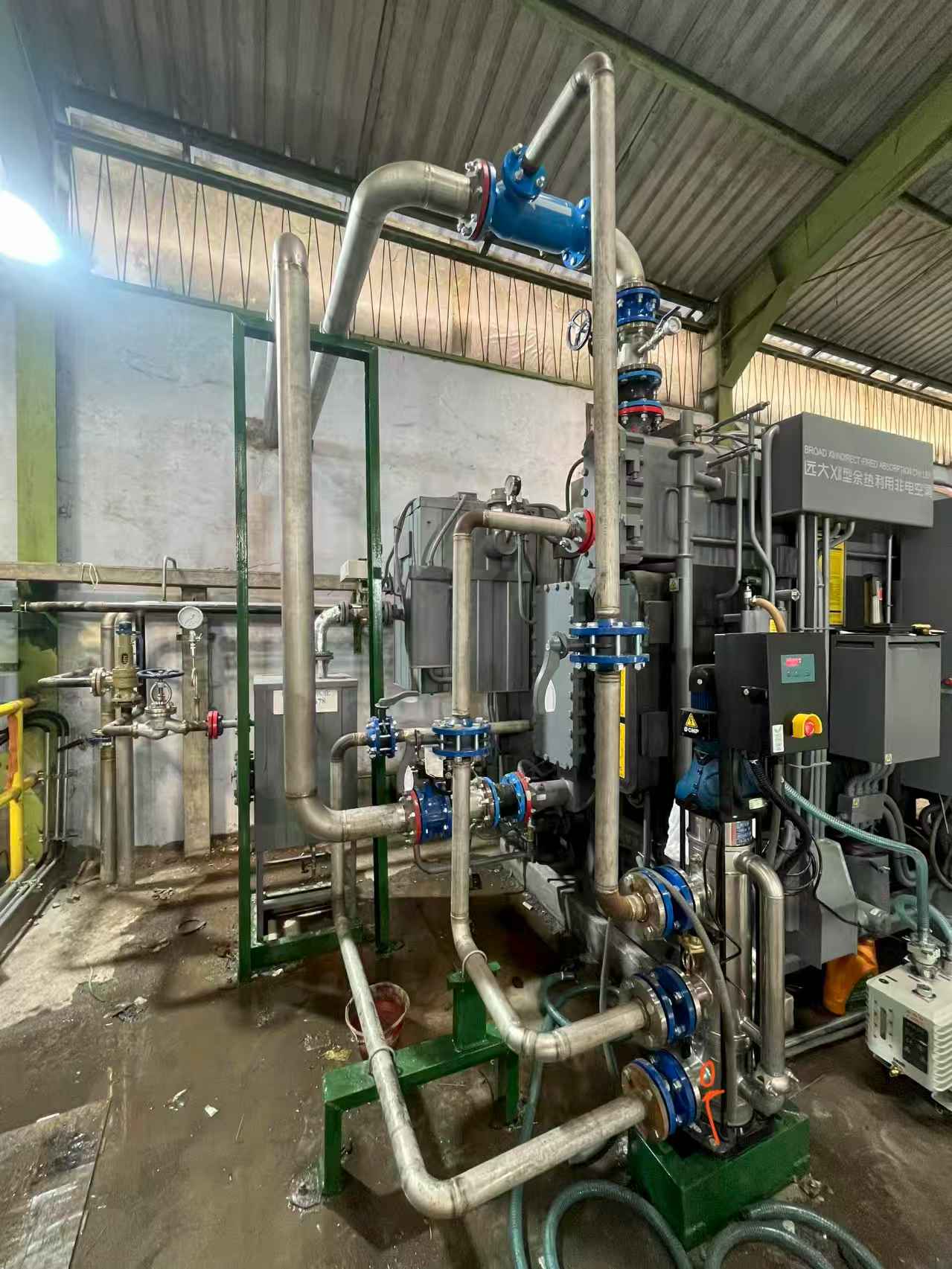
| Client | TK Paper (印尼 TK 纸业), pulp & paper producer, Indonesia |
|---|---|
| Chiller | Broad Air Conditioning (远大空调) lithium bromide (LiBr) absorption chiller |
| Absorber tubes | 3/4 inch, stainless steel |
| Condenser tubes | 1 inch, titanium |
| Condenser pipe size | DN100 |
| Ball ejector | Powered water-pump ejector (motor-driven side-stream injection) with dual-size separation |
| Cleaning balls | Custom 16 mm (absorber) + 24 mm (condenser), sized to each tube |
| Recovery | Separate cleaning, unified recovery through one collector |
| Scope | Condenser and absorber cleaned together, every cycle |
| Result | Online cleaning with no shutdown; electricity cost savings reported (~15%) |
TK Paper (印尼 TK 纸业), a pulp and paper producer in Indonesia, runs its process chilled water on a Broad Air Conditioning (远大空调) lithium bromide (LiBr) absorption chiller. Its absorber carries 3/4-inch stainless-steel tubes and its condenser carries 1-inch titanium tubes, so the plant retrofitted the unit with the HyApexFlow powered online ball-cleaning system: a DN100 side-stream ejector that sends custom 16 mm and 24 mm balls at once to clean both bundles together. TK Paper reports electricity cost savings of about 15% after commissioning, with no production shutdown.
Why a LiBr Absorption Chiller Punishes Dirty Tubes
Absorption chillers transfer heat twice as often as a vapor-compression machine: heat must reject at the condenser and be absorbed at the absorber for the lithium bromide solution cycle to work. In a tropical plant with open cooling towers, both bundles foul continuously — scale, slime and biological growth build up on the tube inner walls. The consequences stack up fast:
- Condensing pressure rises — heat rejection weakens, so the machine needs higher generator temperatures to deliver the same tonnage.
- Capacity and COP drop — the chiller runs longer hours and burns more energy per unit of cooling.
- Crystallization risk climbs — hotter, more concentrated LiBr solution edges toward the crystallization zone, the classic failure mode of fouled absorption machines.
The Retrofit: Dual-Loop Sponge-Ball Online Cleaning
HyApexFlow installed a powered, water-pump ball ejector on the TK Paper Broad LiBr unit (DN100 circuit). The absorber runs 3/4-inch stainless-steel tubes and the condenser runs 1-inch titanium tubes, so we supplied two custom ball diameters — 16 mm balls for the absorber and 24 mm balls for the condenser. The motor-driven ejector launches both sizes at once; a unique separation stage routes each size to its own bundle, so the two heat exchangers are cleaned separately but recovered together through one collector — a fully automatic, online process with no manual sorting. Sponges scrub the inner walls of both bundles on every pass, then a separator captures and returns every ball at each cycle. The whole process runs while the chiller stays online — no shutdown, no end-cover opening, no interruption to the paper-making process downstream.
Reported Results
Per the plant’s feedback, the retrofit cut electricity costs by about 15%. With both bundles kept near design cleanliness, the absorption cycle holds condensing and absorbing pressures down, the machine reaches setpoint in fewer running hours, and auxiliary loads (cooling tower fans and pumps) cycle less aggressively. For a pulp and paper mill where chillers underpin process cooling around the clock, the saving compounds on every shift.
Why a Broad Absorption Chiller Needs Online Cleaning
Broad Air Conditioning (远大空调), headquartered in Changsha, China, is among the world’s largest manufacturers of direct-fired lithium bromide absorption chillers, with units spanning roughly 50–2,600+ tons. Absorption machines are exceptionally sensitive to tube fouling: because the cycle runs under near-vacuum and depends on a precise thermal balance between generator, condenser and absorber, even a thin fouling layer forces higher generator temperatures, drops COP, and pushes the concentrated LiBr solution toward crystallization. An online ball-cleaning system that keeps both the condenser and absorber bundles near design cleanliness is therefore not a convenience but a capacity-protection measure for any Broad (or equivalent) absorption plant running on tropical, open-tower cooling water.
Two Tube Sizes, One Ejector: The Dual-Diameter Ball System
A Broad absorption chiller carries two very different heat-exchanger bundles on the same water circuit. At TK Paper the absorber tubes are 3/4 inch stainless steel, while the condenser tubes are 1 inch titanium. A single ball diameter cannot scrub both properly — too small and it bypasses the 1-inch condenser tubes; too large and it jams the 3/4-inch absorber tubes.
HyApexFlow solved this with a purpose-built ejector and separation design:
- Custom balls, two diameters. We supply 16 mm cleaning balls for the 3/4-inch stainless-steel absorber tubes and 24 mm cleaning balls for the 1-inch titanium condenser tubes — each sized to its own tube so it scrubs the full circumference on every pass.
- One DN100 powered ejector, simultaneous launch. A motor-driven water-pump ejector on the DN100 circuit launches both ball sizes into the stream at the same time. A unique separation and routing stage keeps the two sizes on their correct bundle path instead of mixing them.
- Separate cleaning, unified recovery. The 16 mm and 24 mm balls clean the absorber and condenser independently, then both streams return to a single collector and are recovered together at each cycle — fully automatic, fully online, no manual sorting.
This is the detail that separates a real manufacturer’s retrofit from a generic ball-loop kit: the system is engineered around the actual tube geometry of a LiBr machine, not a one-size assumption. It is the same principle we apply across our Indonesia absorption-chiller deployments below.
Engineering Specs That Decide a LiBr Retrofit
Absorption chillers forgive far less than vapor-compression machines. Four specifications decide whether an online cleaning retrofit helps a LiBr unit or quietly harms it:
- Minimal added pressure drop. Absorption chillers run on a precise thermal balance between evaporator, absorber and condenser. Any added restriction in the circulating loop shifts flow rates and can disturb the unit’s operating vacuum, so the cleaning loop sits outside the main circuit: a side-stream injection loop adds essentially no resistance to the condenser water path.
- High-temperature cleaning media. The condenser-side circuit of an absorption unit runs hotter than a comfort-cooling centrifugal plant, and standard sponge balls degrade faster at these temperatures. The media specified here are heat-resistant EPDM balls rated for continuous service above 50°C (122°F).
- Zero ball loss. A stray ball that escapes the recirculation loop can lodge in narrow heat-exchanger nozzles or the absorber spray system — a particular risk in LiBr units, where blocked spray nozzles accelerate solution crystallization. The ball trap and separator are sized so every ball returns to the injector on every cycle.
- Both bundles cleaned, approach temperature held. Absorber and condenser bundles must be cleaned together. Holding both near design cleanliness keeps the approach temperature close to specification, which stabilizes the LiBr solution’s ability to reabsorb water vapor — the first line of defense against crystallization.
These are the criteria procurement teams now use when qualifying ATCS vendors for absorption-duty plants across Southeast Asia, and the TK Paper arrangement above was designed around them from day one. For the regional water-quality context behind these specs, see our condenser tube cleaning guide for Indonesia, or review the full automatic tube cleaning system range.
HyApexFlow Absorption-Chiller Deployments in Indonesia
Beyond TK Paper, HyApexFlow has retrofitted absorption chillers across Indonesia’s pulp & paper, pharmaceutical, and food-manufacturing sectors — all tropical, open-tower plants where tube fouling is aggressive:
- TK Paper (印尼 TK 纸业) — 1 × Broad LiBr unit, DN100 powered side-stream ejector cleaning condenser and absorber simultaneously with separate 16 mm / 24 mm balls.
- A pharmaceutical manufacturer in Indonesia — 2 × identical LiBr absorption chillers under online ball cleaning.
- A chocolate manufacturing plant in Indonesia — 2 × identical LiBr absorption chillers under online ball cleaning.
Each deployment shares the same engineering logic: keep both heat-rejection bundles clean under tropical cooling-tower water, protect COP, and avoid crystallization risk — without taking the chiller offline.
Applicability Across Southeast Asia
Indonesia’s climate is the stress test for open-tower plants: year-round high wet-bulb temperature, tower water in the ideal band for microbial growth, and F&B production that never stops. This project shows the same online ball cleaning model proven on centrifugal chillers at Changsha IFS and Hilton Xinglong carrying over to LiBr absorption machines — a direct template for food & beverage plants across Indonesia, Vietnam, Thailand and the Philippines.
Running absorption chillers in a tropical plant? Send us your unit model and water data for a saving estimate.
For complete cooling-water management at the plant, the same retrofit can be paired with a HyApexFlow chemical dosing system for automated corrosion, scale and biocide control across the chiller water circuit.
{“@context”:”https://schema.org”,”@type”:”Article”,”headline”:”Indonesia TK Paper Mill: LiBr Absorption Chiller Ball Cleaning”,”description”:”Online sponge-ball cleaning retrofitted on a LiBr absorption chiller at TK Paper in Indonesia, cutting electricity costs by about 15%.”,”author”:{“@type”:”Organization”,”name”:”HyApexFlow (SHENZHEN HONGYUE FLUID INTELLIGENCE)”},”publisher”:{“@type”:”Organization”,”name”:”HyApexFlow”},”about”:”LiBr absorption chiller online ball cleaning verified user report”}
{“@context”:”https://schema.org”,”@type”:”ImageObject”,”contentUrl”:”https://www.hyapexflow.com/wp-content/uploads/2026/10/hyapexflow-libr-dual-ball-cleaning-tk-paper-site.jpg”,”name”:”HyApexFlow sponge-ball cleaning on lithium bromide absorption chiller — Indonesia TK Paper mill”,”description”:”Real-site installation of the HyApexFlow sponge-ball online cleaning system on a lithium bromide absorption chiller at TK Paper in Indonesia, cutting electricity costs by about 15%.”,”author”:{“@type”:”Organization”,”name”:”HyApexFlow”},”about”:”LiBr absorption chiller ball cleaning”}