
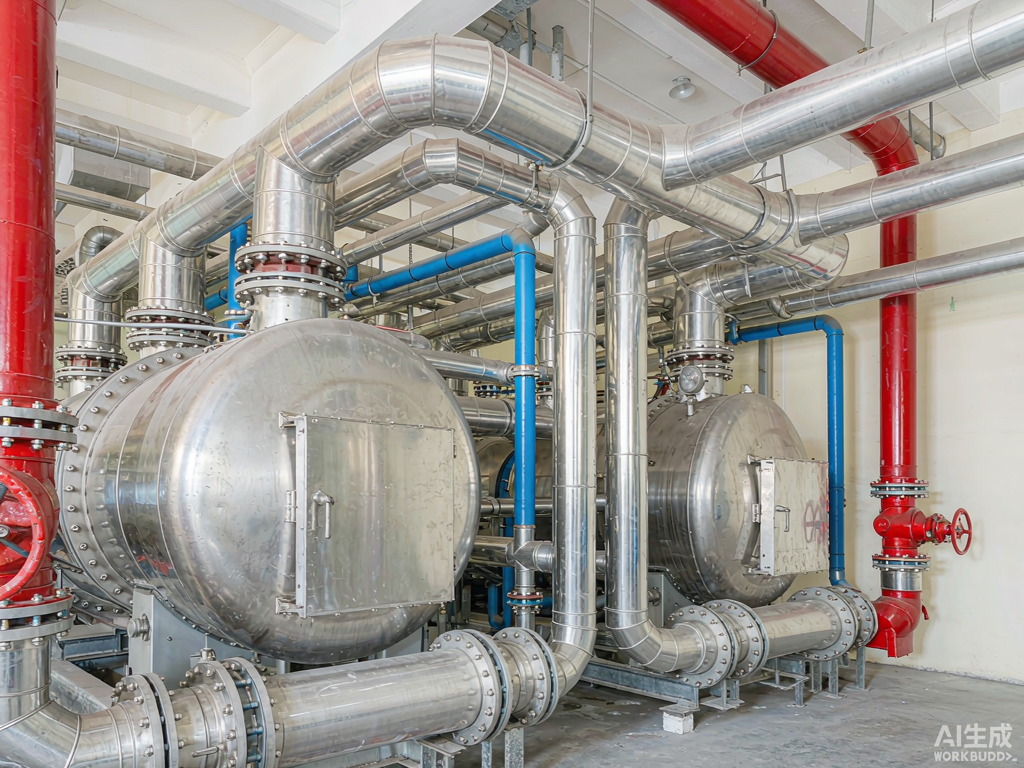
Representative application scenario based on typical project data.
Project Snapshot
A regional hospital (≈800 beds) in East Asia operates a central chiller plant of two 1000-RT centrifugal chillers supporting surgical suites, ICU and general wards on a 24/7 schedule. Cooling cannot stop — even a planned shutdown for condenser cleaning would compromise operating-theatre environmental control.
The Challenge
- Condenser end-difference drifted to ~3.0°C in summer; per the fouling rule of thumb each 1°C of end-difference raises compressor work by ~4%, so the plant was losing roughly 8% of its cooling capacity to fouling.
- Manual brush cleaning required a chiller shutdown the hospital could not schedule.
- Biofilm in the condenser tubes raised infection-control concern and accelerated corrosion.
Solution
Both condensers were fitted with an automatic tube cleaning system (ATCS) using sponge balls (DN100–500 compatible, 0.1 mm oversize for full sweep), running continuously and cleaning every cycle with no shutdown. A constant-pressure water make-up system was added to stabilize make-up and protect the loop.
Representative Results
- Condenser end-difference restored to ~1.2°C and held steady.
- Recovered ~8% effective cooling capacity; estimated 6–9% reduction in chiller electricity use (within the typical up-to-15% envelope for severely fouled plants).
- Zero planned shutdowns for tube cleaning since commissioning.
- Biofilm eliminated, supporting infection-control and corrosion goals.
Why It Matters for Healthcare Facilities
Hospitals are among the hardest environments for condenser maintenance: uptime is non-negotiable and energy is a top operating cost. Online cleaning converts a “shutdown-or-suffer” trade-off into a continuous, automatic process.
Related Products
- Automatic Condenser Tube Cleaning System (ATCS)
- Constant Pressure Water Make-up System
- Hospital Chiller Fouling & Energy Loss
FAQ
Related: All ATCS case studies · Automatic Condenser Tube Cleaning System (ATCS)
Explore more in our our Case Studies →