
Coolant Distribution Unit (CDU)
A liquid-to-liquid coolant distribution unit for data center liquid cooling — the engineered heart of a cold-plate or immersion cooling loop. The CDU isolates the IT coolant loop from the facility water loop through a plate heat exchanger, circulates coolant at precisely controlled temperature and flow, and keeps your data hall running at PUE ≤ 1.15.
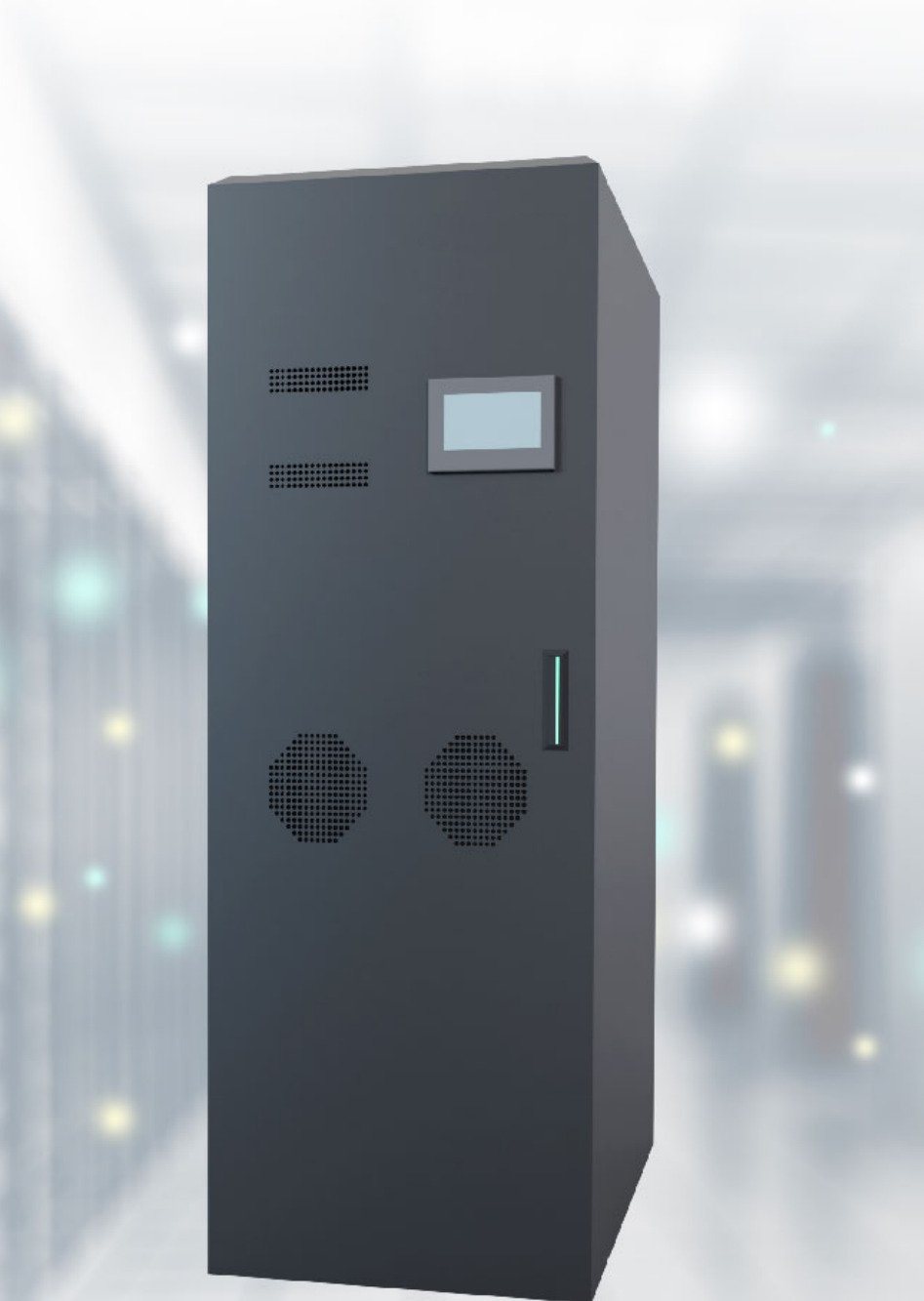
Floor-standing CDU cabinet with 7-inch LCD touchscreen controller — 600 × 1200 × 2000 mm footprint.
What Is a Coolant Distribution Unit?
A coolant distribution unit (CDU) is the pump-and-heat-exchange core of a data center liquid cooling system. It links the technology loop — cold plates or immersion tanks that cool the IT equipment — with the facility loop that rejects heat outdoors.
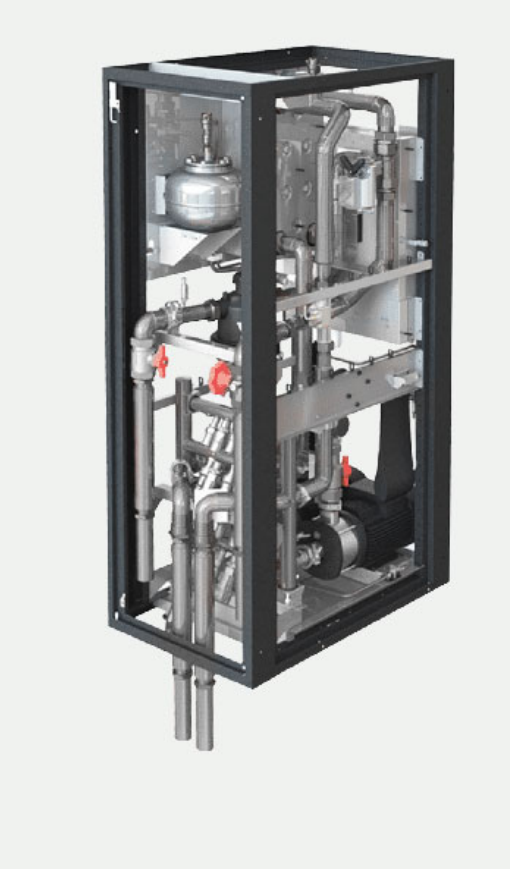
A complete liquid cooling system consists of the heat source (servers), the CDU, prefabricated piping, a coolant distribution manifold, and the power and control systems. The CDU provides a large, compressor-free temperature lift: coolant heated in the racks returns to the unit, where an inverter-driven pump raises its pressure and pushes it through a plate heat exchanger against the primary cooling water. Cooled coolant flows back to the racks in a closed loop, continuously carrying heat away so the IT equipment runs in a stable thermal environment.
Because the two loops exchange heat through plates and never mix, any leak, chemistry problem or particle load on the facility side stays out of the IT coolant — and vice versa. That isolation, plus precision temperature control, is what makes liquid cooling practical at data-hall scale.
How a Liquid-to-Liquid CDU Works
Two hydraulically independent loops, one heat exchanger, one control brain:
1. Heat Pickup (Secondary Loop)
Coolant — deionized water, glycol solution or dielectric fluid — absorbs heat in cold plates or immersion tanks. Outlet temperature from the racks typically sits in the 33–50 °C band, comfortably above dew point: no condensation, no drying needed.
2. Circulation & Control
The CDU’s variable-frequency pump maintains designed flow and available head (≥120 kPa at the manifold). Sensors on both sides feed temperature, pressure, flow and pump status to the PLC, which adjusts speed and bypass continuously — self-adapting as IT load changes.
3. Heat Exchange
Inside the plate heat exchanger, secondary coolant transfers heat to the primary facility water (typical 30/40 °C in/out). The loops never mix: 100 μm primary filtration and 100–200 μm secondary filtration protect plates and racks alike.
4. Heat Rejection
Warm facility water leaves the CDU for the cooling tower, dry cooler or chiller plant. This is where water-side fouling control — the rest of the HyApexFlow portfolio — protects the whole chain.
Key Features
PUE ≤ 1.15, No Compressor
Free cooling by design: warm-water secondary loop (33–50 °C) rejects heat against facility water without compression in most climates, cutting data center PUE to 1.15 or better.
Safe & Reliable
Secondary loop runs above dew point — no condensation on cold surfaces, no need for anti-condensation drying. Multi-year field-proven pump and plate packages.
Fast Delivery
Modular, factory-integrated and pre-commissioned on a skid. Site work shrinks to piping and power connection — commissioning measured in days, not months.
Intelligent Control
7-inch color LCD touchscreen (800×480, 0.5% precision). Three user levels, historical trend curves, alarm log stored on removable MicroSD (3-year retention), variable-frequency pump and bypass for self-adaptive operation.
Broad Coolant Compatibility
Deionized water, ethylene glycol, propylene glycol and dielectric coolants — matched to cold-plate and immersion systems from any server vendor.
Flexible Deployment
Sized to the room, not the rack: supports rack densities from 10 to 80 kW, units from 60 to 360 kW, and integrates with any tower / dry-cooler heat rejection source.
HCDU Series Models & Technical Parameters
Five standard models cover most data-hall densities. Custom capacities and communication protocols are available on request.
| Item | Unit | HCDU-060 | HCDU-120 | HCDU-240 | HCDU-300 | HCDU-360 |
|---|---|---|---|---|---|---|
| Cooling capacity | kW | 60 | 120 | 240 | 300 | 360 |
| Primary loop (facility water) | In/out °C | 30/40 | 30/40 | 30/40 | 30/40 | 30/40 |
| Flow m³/h | 5.5 | 11 | 22 | 27.5 | 33 | |
| Connection | DN40 | DN50 | DN65 | DN65 | DN65 | |
| Secondary loop (IT coolant) | In/out °C | 50/40 | 50/40 | 50/40 | 50/40 | 50/40 |
| Flow m³/h | 5.2 | 10.5 | 21 | 26 | 31.2 | |
| Connection | DN40 | DN50 | DN65 | DN65 | DN65 | |
| Available head (kPa) | ≥120 | |||||
| Coolant outlet temperature range | °C | 33 – 50 (adjustable) | ||||
| Rated electrical power | kW | 0.75 | 1.2 | 2.5 | 3.5 | 4.5 |
| Max working pressure | MPa | 1.6 | ||||
| Noise | dB(A) | ≤75 | ||||
| Operating weight | kg | 220 | 280 | 320 | 400 | 420 |
| Dimensions (W×D×H) | mm | 600 × 1200 × 2000 | ||||
| Category | Specification |
|---|---|
| Primary side medium | Cooling water / brine; filtration 100 μm |
| Secondary side medium | Deionized water / ethylene glycol / propylene glycol / dielectric coolant; filtration 100–200 μm |
| Working environment | 5–50 °C, 5–95% RH (non-condensing); storage −40–70 °C; altitude −30 to 2500 m |
| Power supply | 380–415 VAC / 50±1 Hz |
| Control & monitoring | 7" LCD touchscreen; temperatures, pressures, flows on both loops; pump status / speed / input power; main pump overload and power-failure alarms |
| Subsystems | Plate heat exchanger, variable-frequency circulation pump (1 duty + 1 standby), filters, expansion vessel, motorized control valves, sensors, safety valves, air vents |
Selection note: capacity is chosen from rack count × rack density with a redundancy margin. Tell us your IT load and coolant plan — we size the unit and the heat-rejection side together.
Applications
Cold-Plate Liquid Cooling
AI training clusters, GPU/CPU compute racks from 10 to 80 kW per cabinet. The CDU feeds the manifold that serves every cold plate in the row.
Immersion Cooling
Immersion tanks and pools for ASIC mining, edge computing and high-density retrofits — dielectric coolant loop isolated from facility water.
High-Density Retrofit
Add liquid cooling to existing halls: the CDU connects to the facility chilled/condenser water already on site, with prefabricated pipework for fast deployment.
One Cooling Chain: CDU + Water-Side Care
The CDU is only as good as the loops around it. Heat rejected from the primary loop ends up in your cooling tower or dry cooler circuit — and that is where HyApexFlow’s core expertise lives.
Fouling Control on the Heat-Rejection Side
An open tower loop fouls continuously. Our ball-type ATCS and brush-type online cleaners keep heat-exchanger tubes at design efficiency, so the CDU’s temperature lift stays where you commissioned it.
Loop Water Chemistry
Corrosion inhibitors and biocide for the tower loop, glycol conditioning for glycol-coolant loops — dosed and monitored automatically by our chemical dosing systems.
System Pressurization & Make-Up
Closed loops lose water through seals and service work. Our constant-pressure make-up units keep both loops at design pressure automatically.
See the complete picture: HyApexFlow Data Center Cooling Solutions
Frequently Asked Questions
What does a CDU do in a data center liquid cooling system?
It circulates coolant through the racks and transfers the collected heat to the facility water loop through a plate heat exchanger, keeping the two loops hydraulically isolated. It also controls coolant temperature, flow and pressure — the operating brain of the liquid cooling loop.
Which coolants can the unit handle?
Deionized water, ethylene glycol and propylene glycol solutions for cold-plate systems, and compatible dielectric fluids for immersion systems. Materials, seals and filtration are selected to match the coolant you specify.
How is the CDU connected to the heat rejection side?
The primary side connects to your cooling tower, dry cooler or chiller condenser circuit (typical 30/40 °C). We recommend pairing it with online tube cleaning and automatic water treatment on that loop — fouling on the primary side directly erodes the CDU’s approach temperature and your PUE.
What rack density can one unit support?
The HCDU series is sized for rack densities of 10–80 kW. A single 60 kW unit serves a small AI cluster; larger 240–360 kW units serve rows of high-density cabinets. Send us your rack count and per-rack load for an exact selection.
Can capacity and communications be customized?
Yes. Beyond the five standard models we build custom capacities, and the controller integrates with DCIM/BMS over standard industrial protocols. Units are modular and pre-commissioned, so delivery and site installation are fast.
Planning a Liquid-Cooling Retrofit or New Data Hall?
Send us your IT load, rack layout and coolant plan. We reply within 24 hours with a CDU selection, heat-rejection side check and a complete cooling-chain proposal — CDU, water treatment and make-up as one system.
Prefer email? Write to michealzhang969@gmail.com
For full coolant-loop water chemistry, pair the CDU with a HyApexFlow chemical dosing system — automated corrosion, scale and biocide control that protects the plates, pumps and CDU heat exchangers.
For full coolant-loop water chemistry, pair the CDU with a HyApexFlow chemical dosing system — automated corrosion, scale and biocide control that protects the plates, pumps and CDU heat exchangers.
Related Verified Case Studies
See the HyApexFlow automatic condenser tube cleaning system (ATCS) proven in the field:
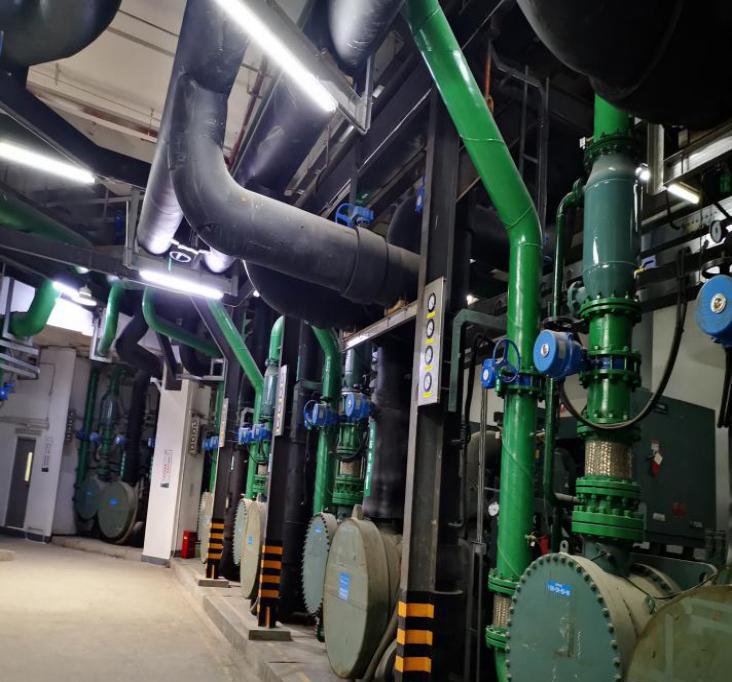
Related: Data Center Cooling Solutions — see how ATCS, CDU, chemical dosing and constant-pressure makeup work together.
Frequently Asked Questions
How does a Coolant Distribution Unit (CDU) work?
A CDU isolates the IT coolant loop from the facility water loop through a liquid-to-liquid plate heat exchanger, then pumps coolant at precisely controlled temperature and flow to cold plates or immersion tanks at the rack level.
What is PUE and why does the CDU matter?
PUE (Power Usage Effectiveness) measures data-centre efficiency. A CDU enables high-density liquid cooling that pushes PUE toward ≤1.15, far below traditional air-cooled halls.
CDU vs chiller — what is the difference?
A chiller produces cold water; a CDU distributes and precisely controls coolant at the IT loop, sitting between the chiller and the servers. The CDU is where temperature stability and loop isolation are enforced.
What capacity range do CDUs cover?
HyApexFlow’s HCDU series covers 60–360 kW per unit, and units run in parallel to scale to larger data halls and high-density AI clusters.
Pair this CDU with ATCS and dosing in a one-package data-center cooling design →
Pair the CDU With Water-Side Efficiency
A CDU moves heat; it does not stop the chiller from fouling. Two complementary units protect the efficiency the CDU is designed to deliver:
- Automatic tube cleaning system (ATCS) — sustains chiller COP by eliminating condenser fouling.
- Automatic chemical dosing system — keeps the cooling loop scale- and corrosion-free.